Currency Exchange in Korea: Stop Losing Money at the Airport

You land at Incheon Airport after a long flight, clear customs, and immediately encounter a queue at the airport bank exchange booth. The rate on the board looks reasonable. You exchange $300 and walk away with your won. What you have just done, without realizing it, is pay one of the worst exchange rates available in South Korea — a spread that can cost you 3 to 5% compared to what you would get in Seoul's exchange markets, effectively losing the cost of a solid Korean BBQ dinner before your first day has begun.
This is not unique to Korea — airport exchange booths worldwide exploit the convenience premium and captive audience dynamic. What is somewhat unique to Korea is how exceptionally good the alternatives are. Seoul has some of the most competitive informal currency exchange markets in Asia, a modern prepaid card system specifically designed for visiting tourists, and a cashless payment infrastructure so developed that many visitors end up needing far less physical cash than they anticipated.
This guide solves the currency question entirely: what to do at the airport, how much cash to actually carry, and where to get the best rates in Seoul.
The Cash vs. Card Reality in 2026: How Much Won Do You Need?
Before optimizing how to get Korean Won, understand how much you actually need. In 2026, South Korea has surpassed a 95% cashless penetration rate. Major cities like Seoul, Busan, and Jeju are virtually "cash-optional," but total cashlessness is still a few years away for the average traveler.
💳 The Rise of Travel-Specific Digital Wallets
By 2026, the local giants KakaoPay and Toss Pay have significantly expanded their support for international travelers. While previously requiring a Korean resident ID, many "Traveler Editions" of these apps now allow you to link a foreign credit card or a WOWPASS balance to pay via QR code—the same way locals do in even the smallest "hole-in-the-wall" restaurants.
Cards & Digital Wallets accepted virtually everywhere:
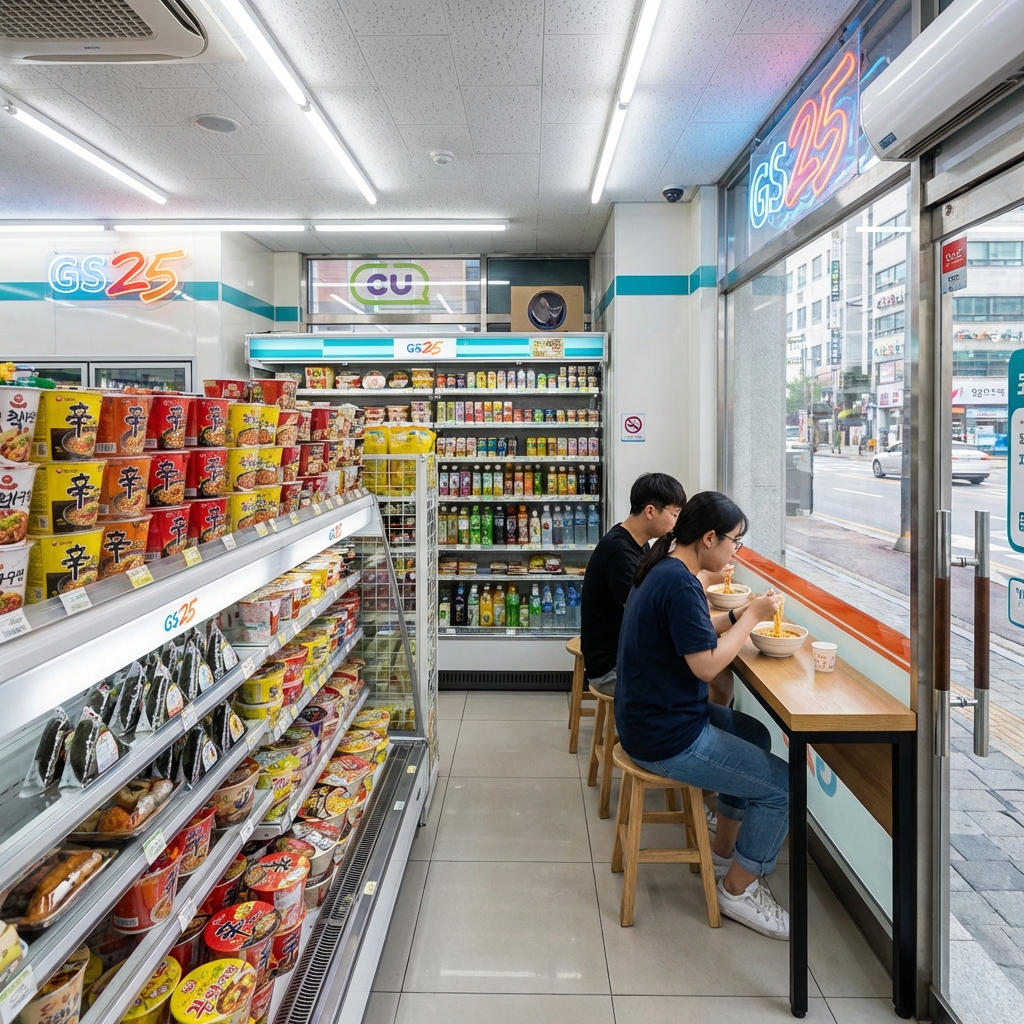
- Convenience Stores: GS25, CU, 7-Eleven, emart24 (QR and Chip)
- Chain Cafes & Retail: Starbucks, Olive Young, Daiso
- Taxis: All taxis accept cards; most now support international Apple Pay and Google Pay via the Kakao T app integration.
- Major Markets: Even in 2026, some vendors in Namdaemun have adopted "Zero Pay" or QR-based payments, though cash remains the king of the stalls.
💵 When You Absolutely Still Need Cash
- T-Money Card Reloads: Crucially, while you can pay for almost everything with a card, the physical vending machines for T-Money (the subway card) still primary accept cash only for top-ups.
- Traditional Street Food: That 3,000 KRW Hotteok (cinnamon pancake) or Tteokbokki in a tent usually requires cash or a local bank transfer (which most tourists can't do).
- Small-Town Buses: If you venture into rural Gangwon-do or Jeollanam-do, some older local buses still prefer cash or T-Money over credit cards.
The 2026 Budgeting Rule: For a 10-day trip, we recommend carrying 150,000 to 250,000 KRW (~$100–$170 USD) in physical cash. This is a decrease from 2024 levels, reflecting the increased acceptance of digital payments.
📈 2026 Exchange Rate Context
As of early 2026, the Korean Won has seen some volatility against the US Dollar and Euro. The average exchange rate is hovering between 1,450 and 1,500 KRW per 1 USD. This means your purchasing power in Korea is currently very high—a "K-BBQ Feast" that might cost $80 in New York can be found for under $35 (approx. 50,000 KRW) in a local Seoul neighborhood.
Method 1: WOWPASS (The Modern Convenience Option)
The WOWPASS is a prepaid debit card and T-Money transit card combined in a single orange card, specifically designed for foreign visitors. It is the most recommended currency solution for visitors who want to minimize decision-making and keep everything on one card.
How WOWPASS Works
-
Find a machine: WOWPASS kiosks are located in Incheon Airport (arrivals hall, both terminals), major subway stations throughout Seoul, and many hotels. The machines are distinctive orange dispensers with English-language interfaces.
-
Get a card: If you don't have one, the machine dispenses a new card for free or a small deposit.
-
Load your currency: Insert your home currency in physical banknotes (USD, EUR, GBP, JPY, CNY, and several others are accepted). The machine converts at its published rate and loads the equivalent KRW to your card.
-
Use it two ways:
- As a T-Money transit card: Tap it at subway gates and buses just like a standard T-Money card
- As a debit card: Chip & PIN payment at any store with a card terminal, accepted on the Visa network
WOWPASS Exchange Rates
The WOWPASS rate is better than airport bank booths but somewhat worse than Myeongdong money changers. Expect to receive approximately 2 to 3% less KRW per dollar compared to the best Myeongdong rate. For a $200 exchange, the difference is roughly 4,000 to 6,000 KRW — the price of a street food snack.
For most visitors, this is a reasonable trade for the convenience of combining T-Money and spending money in one card with no need to carry multiple items.
WOWPASS Practical Notes
- The card can be reloaded at any WOWPASS machine throughout your trip
- Unused balance can be refunded at the machine when departing (small fee applies)
- The card is usable after your trip ends for up to 5 years for any remaining balance
- Track your balance and transactions through the WOWPASS app (available on Android and iOS)
Method 2: Myeongdong Money Changers (The Best Rate)
If you are carrying significant foreign currency in cash (USD, EUR, JPY) and want to maximize every KRW, Myeongdong's private currency exchange booths offer rates that approach the official interbank rate — consistently 2 to 4% better than airport banks and marginally better than WOWPASS.
Why Myeongdong Rates Are Best
The density of exchange booths in Myeongdong creates an intensely competitive market. A dozen or more private operators within 200 meters of each other actively compete for visitors, particularly for major currency pairs (USD, EUR, JPY, CNY). The result is spreads that are genuinely minimal.
Notable Exchange Booths
Money Box (머니박스): Near the Myeongdong main street entrance, Money Box has been a consistently competitive option for years. They display their live rates prominently and allow rate comparison before committing to any exchange.
Embassy Exchange: Located near the Chinese Consulate in the area adjacent to Myeongdong, this booth is particularly competitive for large USD amounts. The name refers to the location, not any official connection.
Multiple unnamed booths along the main Myeongdong pedestrian street also compete. Walk the strip, compare the rates displayed on boards (look for the selling rate of KRW per unit of your currency), and exchange where the number is highest.
How the Exchange Works
The process is completely straightforward:
- Walk in (no appointment)
- State your currency and amount
- The teller shows you the rate and total KRW
- If acceptable, hand over your currency
- The teller counts the KRW in front of you
- Receive your money — transaction complete, no fee, no paperwork for amounts under certain limits
Safety: These are licensed businesses. They are not illegal and they are not dangerous. Pickpocketing while handling cash in the area is a marginal risk (as anywhere in a tourist district), but the exchange process itself is clean. Count your money before leaving the counter.
A note on large amounts: For amounts above $1,000 USD equivalent, bring your passport as some booths request it for regulatory compliance on larger transactions. For smaller amounts, passport is typically not required.
Method 3: Global ATMs (Cash Access Without Pre-Exchange)
If you need KRW and don't want to carry foreign currency, Korean bank ATMs that accept international cards are your option. These are marked with "Global ATM" or international card network logos (Visa, Mastercard, Cirrus, Plus).
Where to find them:
- Inside every Woori Bank branch
- Inside KB Kookmin Bank branches
- Shinhan Bank branches
- All Hana Bank locations
- 7-Eleven convenience stores (many have global ATMs)
- Most large subway station corridors
The ATM Fee Structure
Using a Korean ATM with a foreign card typically involves:
- Korean bank fee: 3,000 to 5,000 KRW per withdrawal (charged by the Korean bank)
- Your home bank's foreign transaction fee: Usually 1 to 3% of the withdrawal amount, depending on your bank and card
- Exchange rate: Determined by Visa or Mastercard's daily exchange rate (usually competitive)
Minimizing ATM costs: Withdraw larger amounts less frequently. Withdrawing 200,000 KRW costs roughly the same flat fee as withdrawing 500,000 KRW — doing the math on a per-transaction basis makes larger single withdrawals more cost-effective.
The DCC Trap: Never Select Your Home Currency
When a Korean ATM (or any payment terminal) asks whether you want to "Pay in Korean Won (KRW)" or "Pay in [your home currency]," always select KRW. Always.
The option to pay in your home currency is called Dynamic Currency Conversion (DCC). The ATM or terminal applies its own exchange rate — which is universally worse than the Visa/Mastercard rate — and routes the currency conversion to the terminal operator rather than your bank. It is legal, clearly labeled, and financially disadvantageous. The prompt is presented as a convenience; it is actually a fee. Select KRW on every transaction, every time.
Method 4: NAMANE Card (The Customizable Option)
NAMANE is a prepaid transit and debit card that functions similarly to WOWPASS but with a distinctive feature: you can customize the card face with any image. Upload a photo of your favorite K-pop idol, a personal photograph, a pet picture, or any design, and the card is printed with your image.
Practical specifications:
- Available at specific kiosks in Hongdae, Myeongdong, and major tourist areas
- Functions as T-Money on all Seoul and nationwide transit
- Chip-enabled for debit purchases at Visa-accepting terminals
- Exchange rates slightly worse than WOWPASS in most comparisons
The appeal is primarily the souvenir dimension. For travelers who want a functional transit card that also doubles as a K-pop themed memento, NAMANE is genuinely fun. For travelers prioritizing exchange rates, WOWPASS or Myeongdong changers are the better financial choice.
⚔️ The 2026 Battle: WOWPASS vs. NAMANE
While both cards offer convenience, the 2026 landscape has created a clear distinction for different traveler types:
| Feature | WOWPASS | NAMANE |
|---|---|---|
| Best For | Financial convenience + High exchange rates | K-Pop fans + Souvenir lovers |
| Top-up Currency | 16 Foreign Currencies (direct cash) | Primarily KRW (Cash/Card) |
| ATM Withdrawal | Fixed 1,000 KRW fee (WOW machines) | Limited (Mostly Convenience Stores) |
| Foreign Card Fee | N/A (Top up with cash) | 3% fee when loading via Int'l Card |
| Customization | Standard Orange Design | Fully Customizable (Your photos/Idols) |
| App Support | Highly intuitive, English-first | Good, but more complex UI |
Verdict: If you are bringing physical USD/EUR/JPY/SGD cash, WOWPASS is the clear winner for the rate. If you don't mind a 3% fee and want a card with your favorite K-pop group's face on it, get a NAMANE.
🏦 Using Neo-Banks: Wise and Revolut in Korea
If you have a Wise or Revolut account, you are in a prime position for 2026 travel. These cards bypass the 3% "currency fee" charged by traditional banks.
The 2026 Strategy for Wise/Revolut Users:
- At the Airport: Do not exchange cash. Go to a Global ATM (Hana Bank or Woori Bank are best for international cards).
- The Fee: You will pay the local Korean ATM fee (usually 3,500 KRW), but the exchange rate will be the mid-market rate provided by Wise/Revolut.
- Withdraw Maximums: To offset the 3,500 KRW fee, withdraw at least 300,000 KRW at once. This makes the fee less than 1.2%, which is unbeatable.
- Tap to Pay: In 2026, most terminals in Seoul support the NFC "tap" function for Wise/Revolut cards. You rarely even need to insert the chip.
At Incheon Airport: The Right Strategy (2026 Edition)
Understanding that airport bank rates are worst-in-class, follow this 2026 checklist upon landing:
- The WOWPASS Kiosk: Skip the bank queues. Head to the WOWPASS kiosk in the arrivals hall (near the AREX entrance). Use your home currency to load your first 50,000 KRW.
- The Digital Path: If you've already linked KakaoPay to your foreign card, you can pay for your airport coffee or convenience store snacks via QR immediately.
- The Minimal Transit Cash: You still need physical cash to load a standard T-Money card if you don't use WOWPASS. If you need it, exchange just $40 USD at the bank—enough for the train and a first meal.
🛡️ Safety & Scams: Protecting Your Won
While South Korea is exceptionally safe, the currency exchange market in 2026 has a few niche "traps" for the unwary:
- The "Dynamic Currency Conversion" (DCC) Trap: When paying with a foreign credit card, the machine might ask if you want to pay in KRW or your Home Currency. Always choose KRW. If you choose your home currency, the merchant's bank sets the exchange rate, which is usually 5–10% worse than your own bank's rate.
- The Myeongdong "Closed-Door" Booths: Stick to booths with visible, digital rate boards. If a booth looks like a private office and requires you to "knock for a rate," walk away. These often target travelers with large amounts of cash and offer substandard "VIP" rates.
- ATM "Skimming" Awareness: While rare, only use ATMs located inside bank branches or major convenience stores. Avoid standalone "unbranded" ATMs in nightlife districts like Hongdae after midnight.
Summary: Your Korean Currency Action Plan
| Situation | Best Solution |
|---|---|
| Need cash immediately on arrival | Exchange $30-50 at airport booth, just enough for transport |
| Primary cash supply | WOWPASS kiosk in Seoul, or Myeongdong money changer |
| Best possible exchange rate | Myeongdong money changer with physical USD/EUR/JPY cash |
| Maximum convenience | WOWPASS (combines T-Money + debit card) |
| Running out of cash mid-trip | Global ATM at any Woori/KB/Shinhan/Hana bank branch |
| ATM payment option | Always select KRW, never your home currency (avoids DCC) |
| Best card for tech-savvy travelers | Wise or Revolut debit card |
🚀 Looking Ahead: The 2027 Digital Won Pilot
As we approach 2027, the Bank of Korea has already begun testing a CBDC (Central Bank Digital Currency). While not yet available for tourists, keep an eye out for news regarding "Digital Won" trials at major department stores during your visit. This is the final step in Korea's journey to becoming the world's first fully cashless society.
For using your KRW effectively once you have it, our Mastering the T-Money Card guide explains how to load and tap for seamless transit, while our Incheon Airport Survival Guide will get you from the arrival hall to your hotel with zero stress. For a complete roadmap of how to spend your travel budget wisely across the country, follow our Ultimate 10-Day South Korea Itinerary for First-Timers.