From Royal Court to Rosé Sauce: The Wild Evolution of Korean Food

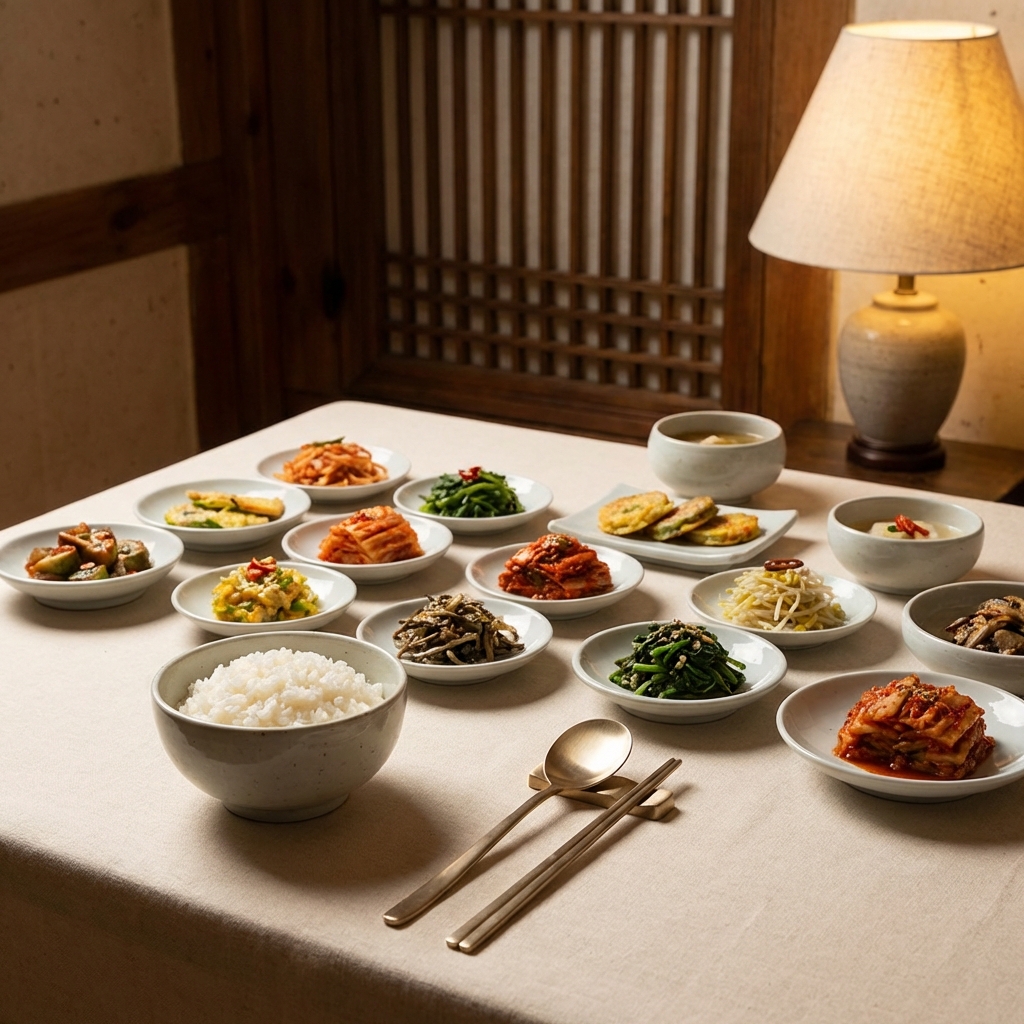
If you ask a Korean grandmother about food, she will talk about "Son-mat" (hand taste) and fermentation that takes months. If you ask a Korean teenager, they will talk about "Map-Dan-Jjan" (Spicy, Sweet, Salty) and pouring cheese on everything.
Korean cuisine is currently in a fascinating civil war between its healthy, balanced roots and its hyper-palatable, viral future. To understand Korea, you must taste both the silence of the Royal Court and the chaos of the modern street market.
1. The Soul of the Past: The Joseon Dynasty
Traditional Korean food is slow. It is based on the philosophy of "Yak-sik-dong-won"—the belief that food and medicine share the same origin.
Surasang: The King's Table
Historically, the Royal Court cuisine (Gungjung Eumsik) was surprisingly mild. Unlike the fiery red dishes we associate with Korea today, the King's table was defined by balance. The "Surasang" featured 12 side dishes (Banchan) meticulously arranged to cover the five elements and five colors (Obangsaek): red, green, yellow, white, and black.
There was no chili powder to mask the flavor. Instead, dishes relied on deep savoriness from soy sauce (Ganjang) and fermented bean paste (Doenjang). It was elegance in restraint.
The 5 Mother Sauces of Korean Cuisine
Before a single grain of rice is cooked or a single cut of meat is marinated, the soul of Korean cuisine already exists in a clay pot somewhere, quietly transforming. If French cooking has its five mother sauces, Korean cooking has its five fermented foundations — and understanding them is the single fastest way to understand why Korean food tastes unlike anything else on earth.
Ganjang (Soy Sauce) is the oldest and most versatile. Korean Ganjang differs fundamentally from Japanese or Chinese soy sauce; it is made from fermented soybean blocks (Meju) and salt water, then aged for anywhere from one to several years in large earthenware jars (Onggi). The result is a deeper, earthier liquid with a complexity that bottles labeled "soy sauce" at the grocery store can only approximate. It seasons soups, anchors namul (seasoned vegetable side dishes), and forms the base of the King's table's refined flavor.
Doenjang (Fermented Soybean Paste) is what's left in the jar after the Ganjang is drawn off — a thick, pungent paste that Koreans correctly regard as a superfood. A bowl of Doenjang Jjigae (fermented bean paste stew) with tofu and zucchini is arguably the most universally eaten dish in Korea. The fermentation process takes a minimum of three months but traditionally ran for years. The older the Doenjang, the more prized it is. A grandmother's five-year Doenjang is a family heirloom.
Gochujang (Chili Paste) is the ingredient most responsible for Korea's global flavor identity. Made from red chili powder, fermented soybeans, glutinous rice, and salt, it is simultaneously spicy, sweet, savory, and faintly sour. Minimum fermentation: six months. Premium versions age for three years. It is the backbone of Tteokbokki, the marinade in Bibimbap, and the dipping sauce at every Korean BBQ table.
Ganjang Gejang (Soy-Marinated Raw Crab) is less a condiment and more a phenomenon. Raw crab marinated in aged soy sauce for weeks, it is so intensely savory and umami-rich that Koreans call it bap-doduk — "rice thief" — because a single crab will compel you to eat bowl after bowl of rice. It is the dish that separates the curious traveler from the truly devoted.
Jeotgal (Fermented Seafood) is the ingredient that most Western palates underestimate and most Korean cooks consider non-negotiable. Salted and fermented shrimp (Saeujeot), oysters, squid, or anchovy paste (Myeolchi Aekjeot) are mixed into Kimchi to accelerate fermentation and add that characteristic deep funk that no amount of fresh ingredients can replicate. Without Jeotgal, Kimchi tastes flat. With it, Kimchi tastes like Korea.
These five foundations have not meaningfully changed in over five centuries. You can pour cheese on Tteokbokki all you want — and you should, it is delicious — but the Gochujang underneath it has been made the same way since the Joseon Dynasty.
2. The Game Changer: When Chili Met Cabbage (17th Century)
The turning point in Korean culinary history arrived with the Portuguese and Japanese trade routes in the late 16th and early 17th centuries: the chili pepper.
Before this, Kimchi was white (Baek-kimchi), made simply with salt and water. The introduction of chilies transformed it into the red, spicy powerhouse we know today. The chili wasn't just for flavor; it helped preserve food longer and kept the body warm during Korea's brutal winters. This moment defined the "Red Korea" that the world recognizes today.
The Kimchi Ecosystem: More Than Just Cabbage
Most travelers arrive in Korea knowing one Kimchi: the red, fermented napa cabbage (Baechu Kimchi) that arrives at every table as a matter of course. What they discover — often by accident, usually with delight — is that Kimchi is not a dish. It is an entire culinary universe with over 200 documented varieties.
Kkakdugi (cubed radish Kimchi) has a satisfying crunch and a cleaner, more refreshing heat than cabbage Kimchi. It is the traditional companion to Seolleongtang (ox bone soup) and is the variety most Korean families eat through the depths of winter.
Oi-sobagi (stuffed cucumber Kimchi) is made by slitting cucumbers and packing them with a mixture of garlic chives, chili flakes, and seasoning. It is a summer Kimchi, eaten fresh and crisp rather than fermented for weeks. On a hot August day in Seoul, a plate of Oi-sobagi is exactly what the doctor ordered — presuming the doctor is Korean.
Gat Kimchi (mustard greens Kimchi) is the specialty of the Jeolla Province and carries a peppery, slightly bitter edge that distinguishes it from all others. The greens wilt and tangle during fermentation into something deeply savory and complex. Food writers who eat it for the first time often describe it as the Kimchi that finally made them understand what all the fuss is about.
Baek-kimchi (white Kimchi, the pre-chili original) still exists and is served in traditional restaurants and temple kitchens. Made without chili and seasoned with garlic, ginger, pine nuts, and jujube, it is pale, gentle, and almost startlingly elegant. Tasting it alongside standard Baechu Kimchi is an immediate, edible lesson in how profoundly one ingredient can transform an entire cuisine.
The crown jewel of Kimchi culture, however, is not a variety but an event: Kimjang. Every November, before the temperatures drop below freezing, Korean families and communities gather to make enormous quantities of Kimchi that will last through winter. The scale is industrial: it is common for a single family session to produce 100 to 200 heads of cabbage worth of Kimchi in a single day. Neighbors share labor, ingredients, and recipes. The elderly teach the young. Hands are stained red for days.
UNESCO recognized Kimjang as an Intangible Cultural Heritage of Humanity in 2013 — not just for the food itself, but for what the practice represents: collective labor, seasonal attunement, and the transmission of knowledge across generations. If you are in Korea in November and receive an invitation to a Kimjang session, accept it without hesitation. You will leave with red hands, a full stomach, and a jar of Kimchi that will taste better than anything you have ever bought at a store.
3. Survival & Innovation: The Korean War Era (1950s)
The next major leap happened during the desperate years after the Korean War. Food was scarce, and American army bases were the only source of protein.
The Birth of Budae Jjigae
Mothers took surplus Spam, hot dogs, and baked beans from U.S. bases and boiled them into a spicy Kimchi stew. Budae Jjigae ("Army Base Stew") was born—a dish of survival that became a national obsession. It was the first true "Fusion" dish, proving that Korean cuisine could absorb foreign ingredients and make them undeniably Korean.
The Rise of Wheat
Around the same time, U.S. aid flooded the country with wheat flour. The government encouraged people to eat noodles instead of the scarce rice. This policy gave birth to cheap, beloved staples like Jajangmyeon (Black Bean Noodles) and the instant Ramyeon culture that powers the nation today.
The Miracle of the Han River: The 1960s–1980s Food Revolution
Between the 1960s and 1980s, South Korea underwent one of the most dramatic economic transformations in recorded history — GDP per capita rising from under $100 to over $2,400 in three decades. The "Miracle on the Han River" created something the Korean peninsula had never seen before at scale: a middle class with disposable income and a desire to eat well after a long day at work.
This new social reality produced the institution that now defines Korean food culture worldwide: Korean BBQ.
The tabletop grill as we know it today is a modern invention. Traditional meat cooking in Korea was reserved for special occasions; beef was rare and expensive. What democratized meat-eating was the combination of rapid economic growth, the development of tabletop charcoal and later gas grills, and the social ritual that grew up around them. Samgyeopsal (thick-cut pork belly) became the great equalizer — cheap enough for anyone, delicious enough for everyone, and structured around the Ssam (lettuce wrap) culture that makes eating it an inherently communal act. You cannot eat Samgyeopsal alone without feeling vaguely sad about it.
The Ssam tradition — wrapping grilled meat in a perilla leaf or romaine lettuce with a smear of Doenjang paste, a sliver of raw garlic, and a piece of green chili — is deceptively simple but perfectly balanced. It is also, incidentally, a health food masquerading as indulgence: leafy greens, fermented paste, protein. Your grandmother would approve.
The 1980s also gave the world its most consequential Korean food export: Shin Ramyun, launched by Nongshim in 1986. The brick of dried noodles in the red package became the defining flavor of an entire generation of Koreans and, eventually, a global phenomenon available in over 100 countries. In a very real sense, Shin Ramyun was the first K-Food to go viral — decades before the word "viral" existed in its current meaning. The instant ramen aisle of any Korean supermarket, stacked floor to ceiling with dozens of varieties, is one of the more hypnotic sights available to the food traveler. Budget at least 20 minutes and a significant portion of your luggage allowance.
4. The Modern Boom: Cheese, Rosé, and "Newtro"
In the 21st century, K-Food went global, and the world's feedback looped back into Seoul's kitchens.
The "Rosé" Craze
Recently, a trend called "Rosé" took over. It isn't wine; it's a sauce made by mixing spicy Gochujang with heavy cream and milk. Rosé Tteokbokki became a viral sensation. It represents a generational shift: younger Koreans, influenced by Western pasta, wanted the comfort of cream to temper the traditional spice.
The Cheese Invasion
Why is there mozzarella on everything? From Cheese Dakgalbi (spicy chicken) to K-BBQ fried rice, cheese is everywhere. It serves a functional purpose: it acts as a "neutralizer" for the extreme heat of modern spicy dishes (like the "Fire Noodle" challenge). It balances the "Map-Dan-Jjan" trifecta—Spicy, Sweet, and Salty—that is the holy grail of modern K-Food.
5. The Hallyu Food Effect
Here is a statistic that illustrates just how much cultural soft power can move actual supply chains: Korean frozen food exports increased by approximately 40% in 2023, driven in large part by demand from markets where K-Drama and K-Pop had established a foothold. Korean cuisine did not go global because of a government food initiative or a well-funded tourism campaign. It went global because people watched a television show and immediately wanted to eat what the characters were eating.
The specific moments of food-driven pop culture are worth cataloging. When Squid Game aired in 2021, Dalgona candy — the brittle honeycomb toffee pressed into shapes that players had to carefully carve out with a needle — became a worldwide phenomenon overnight. Cafes from New York to Bangkok reported selling out of the ingredient (brown sugar, baking soda, a copper ladle) within days. A confection that most Koreans associated with childhood nostalgia and street vendors outside elementary schools suddenly had a global waiting list.
K-Drama has been performing this function for years with less spectacle but equal effectiveness. The "black bean noodles on White Day" trope — the bittersweet Korean tradition of single people eating Jajangmyeon on April 14th (Black Day) after receiving nothing on Valentine's or White Day — has been dramatized in so many series that it has become internationally recognized shorthand for romantic disappointment. BTS has publicly expressed their love for Japchae (glass noodles stir-fried with vegetables and beef), a traditionally festive dish, driving measurable sales increases in markets where the group has a following.
Shin Ramyun is now available in over 100 countries. Bibigo dumplings (Mandu) are sold in Costco warehouses across North America. Korean fried chicken chains have opened locations in multiple continents. The global appetite for Korean food is not a trend; it has the structural characteristics of a permanent shift.
The more interesting story, however, is the feedback loop. As Korean food becomes globally popular, global flavors influence what young Koreans want to eat at home. The Rosé sauce craze was directly inspired by Western pasta culture. The current enthusiasm for Korean-style cream-based soups draws on both American comfort food and Italian influences. Young Korean chefs who trained in France or Japan return home and open restaurants that are described as "Korean" but draw from an entirely international toolkit. The result is a cuisine that is simultaneously more globally influential and more globally influenced than at any point in its history. Call it culinary globalization; Koreans tend to just call it dinner.
6. The Vegan and Health Revolution
Here is the paradox that no food writer can resist: the country that puts mozzarella on rice cakes and Spam in its stew is simultaneously developing one of the world's most sophisticated plant-based culinary traditions.
Sachal Eumsik — Buddhist temple food — has existed in Korea for over a thousand years, predating any modern understanding of plant-based eating by centuries. Temple cuisine operates under strict rules: no meat, no fish, no garlic, no green onions, no leeks, no chives, and no alcohol. These five pungent vegetables (Osinchae) are avoided because they were believed to excite the passions and disturb meditation. What remains is a cuisine of extraordinary restraint and creativity: fermented mountain vegetables, seasoned wild greens, slow-cooked mushroom broths, and grain dishes that achieve a depth of flavor through technique rather than intensity.
The restaurant Balwoo Gongyang in central Seoul, run by the Jogye Order of Korean Buddhism, has brought temple cuisine to mainstream and international attention. It holds a Michelin star and operates out of a building adjacent to the Jogyesa Temple. Eating there is not a compromise or a novelty for non-Buddhists; it is one of the most genuinely moving dining experiences available in Seoul, where the food carries the weight of an unbroken philosophical tradition.
What has changed recently is that Chae-sik (plant-based eating) has moved beyond its temple origins to become fashionable among Korean millennials and Gen Z. Health consciousness, environmental awareness, and the influence of global wellness culture have created a new wave of plant-forward Korean restaurants that interpret traditional ingredients — fermented pastes, wild greens, dried mushrooms, sea vegetables — through a contemporary lens.
The traditional Korean diet, at its core, was already largely plant-based. The Banchan spread that appeared on the King's table and on every Korean dinner table since was predominantly vegetables: seasoned spinach, braised burdock root, stir-fried zucchini, pickled radish, blanched bean sprouts. Meat was a condiment, not a centerpiece. The modern cheese-and-Spam era represents a historical blip — an overcorrection driven by post-war scarcity followed by prosperity — and younger Koreans are increasingly returning to the fermented, vegetable-forward foundation their grandmothers built their health on. The grandmother and the teenager, it turns out, are not as far apart as they seem.
7. Experiencing the History on Your Plate
You don't have to read a history book to understand this. You just have to eat.
- For the Past: Visit a Hanjeongsik restaurant in neighborhoods like Insadong or near Bukchon Hanok Village. You will be served a table full of 20+ small, healthy, fermented dishes that taste of the earth and the seasons.
- For the Future: Head to the neon streets of Hongdae or Ikseon-dong. Walk into a loud Pocha (pub). Order a sizzling pan of spicy chicken covered in a blanket of melted cheese. It will be loud, intense, and incredibly flavorful.
A Foodie's Guide to Seoul by Era
For the traveler who wants to eat through Korean history in chronological order, Seoul and its surroundings offer a remarkably intact trail. Here is how to structure it.
Joseon-era flavors are best experienced in three places. In Seoul, the neighborhood of Insadong still has Hanjeongsik restaurants where a single meal unfolds across a table of 20 or more small dishes, each a meditation on a single ingredient and a single fermented condiment. Near Bukchon Hanok Village, the traditional wooden houses provide an appropriate backdrop for exploring Royal Court-influenced cuisine. For the most immersive experience, travel to Jeonju, the food capital of the Jeolla Province and the city that most food scholars consider the heart of traditional Korean cuisine. Jeonju's Hanok Village district is home to restaurants that have been serving the same recipes for generations — and its version of Bibimbap, considered the definitive preparation, uses a stone pot heated until the rice at the bottom turns golden and crisp.
War-era nostalgia has its own pilgrimage sites. Uijeongbu, a city just north of Seoul, is the acknowledged birthplace of Budae Jjigae — the original army base stew is credited to this area, where U.S. military installations were concentrated. Several restaurants in the city claim to serve the "original" version, and the debate between them is as unresolvable and entertaining as any great culinary argument. In Seoul itself, Sindang-dong Tteokbokki Town is a covered market alley that has specialized in the spicy rice cake dish since the 1950s, when it was a cheap, filling meal for workers and students. The restaurants here use a tabletop cooking format that lets you customize the spice level and add-ins, turning the experience into something between a meal and an art project.
1980s comfort food lives in the Pojangmacha culture — the orange-tented street stalls that appear across Seoul at dusk and serve soju, fish cake skewers, and fried snacks to office workers unwinding after long hours. The Mapo-gu district, particularly around Mapo and Gongdeok stations, still has a density of old-school pojangmacha. The ritual is specific: perch on a low plastic stool, order a bottle of soju and a plate of Eomuk (fish cake soup), and watch Seoul exhale. Kimbap restaurants — the Korean answer to fast food, serving rice rolls stuffed with pickled radish, egg, spinach, and imitation crab — also hit their peak in this era and remain the most affordable, reliable meal available anywhere in the country.
21st-century innovation is concentrated in three neighborhoods. Ikseon-dong in central Seoul is a grid of narrow alleyways lined with low traditional buildings that have been converted into cafes, wine bars, and experimental restaurants. The aesthetic is "Newtro" (nostalgic-new) and the food follows: traditional ingredients in unexpected presentations, heritage grains in modern pastries, fermented kombucha alongside Makgeolli rice wine. Seongsu-dong, east of the Han River, is the Brooklyn of Seoul — repurposed industrial buildings housing fusion restaurants, artisan coffee roasters, and brunch spots that combine Korean and Western breakfast traditions with genuine creativity. Yeouido, the financial district on the Han River, has seen an explosion of trendy cafe-restaurants catering to the young professional class, with a particular strength in the new wave of plant-forward Korean cuisine that draws on temple food traditions while presenting them in a thoroughly contemporary vocabulary.
Both are authentic. Both are Korean. And experiencing the contrast between the Royal Table and the Rosé Sauce is the best way to understand how far this country has come. To deepen your understanding of the traditional side, explore the traditional Korean tea ceremony, or jump into the social heart of modern life with our manual to Korean drinking culture. And for the ultimate hands-on history lesson, don't miss our guide to Seoul's top 15 street foods.