Hiking Etiquette in Korea: What to Wear and How to Behave
In South Korea, a mountain isn't just a place to walk; it's a place to perform. If you've ever stepped onto a Korean hiking trail in a pair of casual cotton gym shorts and a t-shirt, you likely felt the immediate, though polite, weight of being "underdressed."
Hiking in the Land of the Morning Calm is a deeply ingrained cultural phenomenon. With mountains covering over 70% of the peninsula, the peaks are the country’s communal backyard. But unlike a casual stroll in a Western park, Korean hiking comes with a set of unspoken rules, a specific dress code, and a communal spirit that turns a physical challenge into a social event. If you want to not only survive but thrive on the Korean ridges, you need to understand the etiquette.
Whether you’re scaling the rocky heights of Bukhansan in the heart of Seoul or chasing the Fall Foliage in Seoraksan, knowing how to navigate the social landscape of the trail is just as important as knowing the path itself. Here is everything you need to know about "fitting in" on the mountain.
The "Full Gear" Phenomenon: Why Everyone Looks Like a Pro
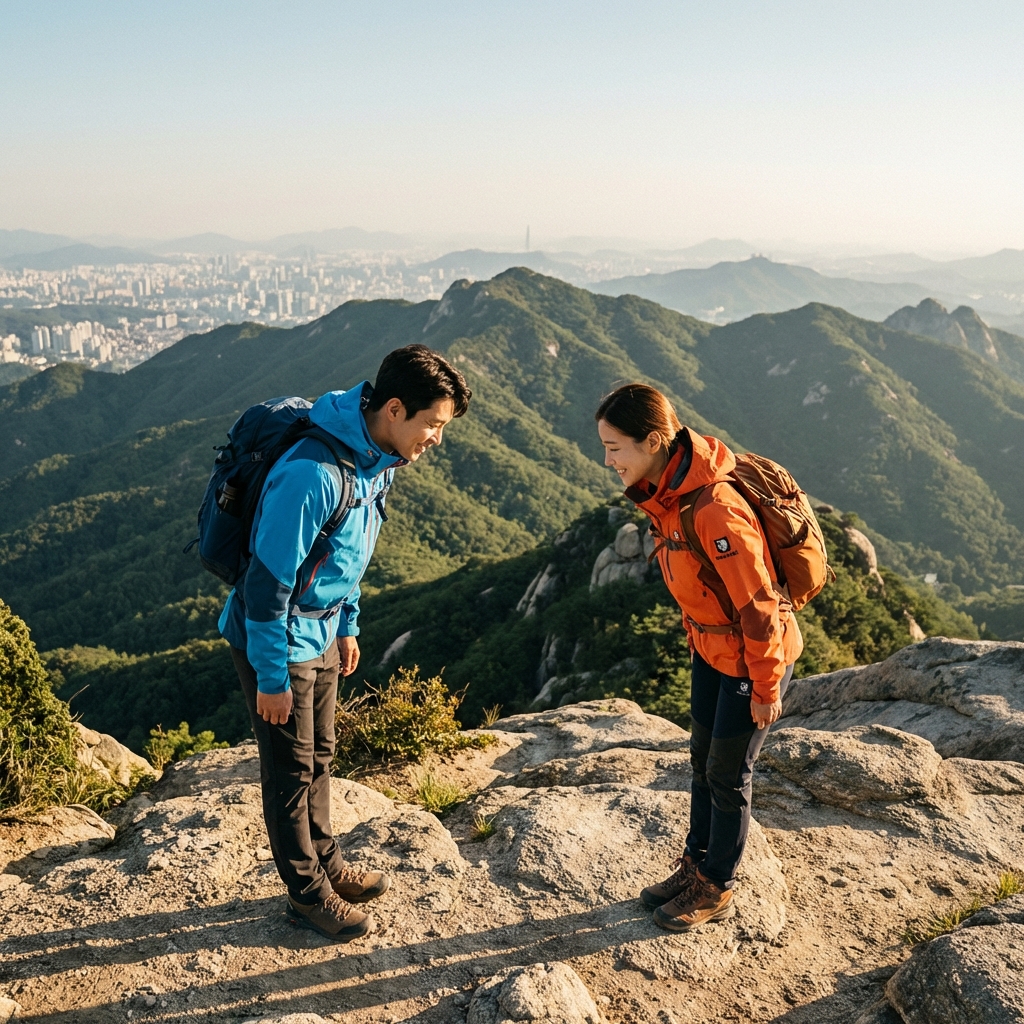
The first thing you’ll notice at any trailhead is the fashion. You will see 70-year-old grandmothers (Ajummas) and grandfathers (Ajusshis) head-to-toe in high-end technical gear: vibrantly colored Gore-Tex jackets, moisture-wicking leggings, high-cut hiking boots, and dual trekking poles.
The Aesthetic of Respect
In Korea, dressing well for the hike is a sign of respect for the activity and the mountain itself. While you don't need to spend $1,000 on a new wardrobe, there is one rule that is non-negotiable: No Cotton!
Korean mountains are primarily composed of granite, meaning the trails are steep and the weather at the top can be drastically different from the base. Cotton absorbs sweat, stays heavy, and can lead to rapid cooling once you hit the windy ridges. To look (and feel) like a local, stick to synthetic blends or merino wool.
[!TIP] Local Pride: Brands like Black Yak, Kolon Sport, and NEPA are the gold standards here. If you want to truly blend in, visit an outlet mall and pick up a brightly colored windbreaker. In Korea, being visible is being fashionable.
Trail Greetings: The Magic of "Annyeonghaseyo"
On the crowded streets of Gangnam, Koreans value personal space and silence. On the mountain, that rule disappears.
The hiking trail is one of the few places in Korean society where strangers regularly acknowledge one another. As you pass someone, a short, polite "Annyeong-haseyo" (Hello) or even a simple "Sugo-haseyo" (Keep up the hard work) is the standard.
The Hierarchy of the Peak
Respecting age is fundamental to Korean culture. If an older hiker is moving faster than you, step aside and let them pass. Often, you’ll find that these older hikers have incredible stamina and will happily offer you words of encouragement (or even a piece of fruit) as they glide past you on the "Path of Stairs."
Navigational Nuances: Stay Right and Step Aside
Because Korean trails are often composed of narrow stairs or single-track paths, navigation is a coordinated effort.
- The Right-Side Rule: Always walk and pass on the right.
- Right of Way: Generally, the hiker going uphill has the right of way. If you are descending, step aside onto a stable rock to let the climber maintain their momentum.
- Noise Levels: While the mountain is a social place, blasting K-Pop from a pocket speaker is generally frowned upon (though you will still see the occasional "radio-hiker"). Use headphones to preserve the natural silence for others.
The Mid-Mountain Picnic: Sharing is Caring
For many Koreans, the highlight of the hike isn't reaching the summit; it's the lunch break. Groups will often carry elaborate picnics of kimbap, sliced fruit, kimchi, and even boiled eggs.
The "Makgeolli" Culture
You may also see hikers sharing small cups of Makgeolli (Korean rice wine). While drinking is common, it is usually done in moderation. If a group offers you a piece of apple or a small cup of wine, it is polite to accept with both hands and a bow. Declining is okay, but accepting a small gesture often leads to the best conversations of your trip.
"Leave No Trace": A National Duty
You will notice something surprising on most Korean mountains: there are no trash cans.
Korea operates on a strict "Carry In, Carry Out" policy. Hikers are expected to bring a small plastic bag and take every bit of waste—including fruit peels—back home with them.
[!IMPORTANT] No Picking!: National Parks have strict rules against picking wildflowers, taking rocks, or disturbing the flora. The mountains are precious, and the rangers take environmental protection very seriously.
Summit Photos and Group Pride
Reaching the summit stone (Baekyudaebong) is the moment of truth. You will often find a queue of people waiting to take their photo with the official mountain marker.
- Etiquette: Take your photo quickly and move aside. If you see someone hiking alone, offer to take their photo—they will almost always return the favor.
- Group Photos: Korean hiking clubs are famous for their coordinated group shots. Give them space; these photos are often the highlights of their weekly newsletters and social media!
Conclusion
You don't need the most expensive gear to be a "Professional" in the eyes of Korean hikers. What matters most is your attitude—be prepared, be polite, and be prepared to say "Annyeonghaseyo" a hundred times. To use these rules on real routes, start with the coastal options in 10 Best Coastal Trails in South Korea for Breathtaking Sea Views or the granite climbs in Seoraksan National Park. If you want a quieter recovery-focused version of the outdoors after a demanding hike, continue with Healing Stays: Best Wellness Retreats and Forest Therapy in Korea.
Quick Trail Decision Guide
If you are unsure how to behave on a trail, choose the least disruptive option.
Before You Start
- Wear layers you can remove quickly
- Carry water and a small trash bag
- Check whether the trail has rock scrambles, mud, or temple zones
- Arrive earlier than you would for a city walk
On the Trail
- Let faster hikers pass on narrow sections
- Keep voice volume low near temples and scenic viewpoints
- Step off the path only where it is safe and obvious
- Do not blast music or take up the whole trailhead bench area
After the Hike
- Clean your shoes before entering public transport or a café
- If you sweat heavily, change shirts before a long ride back
- Eat and hydrate before planning the next climb
The Korean Hiking Brand Ecosystem: What to Wear
The "Full Gear" culture has its own economy. Understanding it helps you look the part — and dress appropriately for the terrain.
| Brand | Tier | Price Range | Known For |
|---|---|---|---|
| Black Yak | Premium | ₩150,000–₩500,000/jacket | Technical Gore-Tex, favored by serious hikers |
| Kolon Sport | Premium | ₩120,000–₩400,000 | Fashion-forward colorways, good ventilation |
| NEPA | Mid-Premium | ₩80,000–₩250,000 | Balanced price/performance, popular among 50+ hikers |
| The North Face Korea | Mid | ₩100,000–₩300,000 | International brand, widely available |
| K2 Korea | Mid | ₩70,000–₩200,000 | Affordable gateway into technical fabrics |
| Lotto / Sportive | Budget | ₩30,000–₩80,000 | Entry-level, fine for day hikes |
Where to Shop: The Dongdaemun Outdoor Market (near Dongdaemun History & Culture Park Station, Line 2/4/5) has the densest concentration of hiking gear shops in Asia. You can equip yourself completely for ₩150,000–₩200,000. Lotte and Hyundai department stores carry the premium brands at full price; outlet malls in the suburbs often have 30–50% discounts.
Complete Gear Checklist: What to Bring on Korean Trails
Different mountains require different preparation. Here is a tiered gear checklist:
For Short Day Hikes (under 5 km, urban mountains like Bukhansan, Namsan)
| Item | Notes |
|---|---|
| Trail shoes or sneakers | No flip-flops — granite is slippery when wet |
| Synthetic T-shirt | No cotton |
| Light windbreaker | Summits funnel cold wind even in summer |
| 1.5L water | No refill stations on most trails |
| Snacks | Kimbap, energy bars, trail mix |
| Phone with Naver Maps or Durunubi | Download offline before entry |
| Small trash bag | No bins on trails |
For Full-Day Hikes (Seoraksan, Jirisan, Hallasan — 8–15 km)
Everything above, plus:
| Item | Notes |
|---|---|
| Trekking poles | Standard in Korea; dramatically reduces knee strain on granite descents |
| Moisture-wicking base layer | Long-sleeve for sun/wind protection |
| Gaiters | Useful in spring (mud season) and winter (snow) |
| Hiking pants (not jeans) | Jeans are genuinely dangerous when wet on granite |
| First aid kit | Blister pads, elastic bandage, antiseptic wipe |
| Emergency whistle | Required in National Parks; available at trailhead shops for ₩2,000 |
| 3L water + water filter | Some Jirisan trails have no water sources for 8+ hours |
| Headlamp | If you plan to summit at dawn or finish after dark |
Understanding Korean Trail Difficulty Ratings
Korean National Parks use a standardized color system for trail difficulty:
| Color | Difficulty | Description |
|---|---|---|
| Green | Beginner | Gentle gradient, wide path, suitable for families |
| Blue | Intermediate | Moderate inclines, some stone steps, 3–5 hour hikes |
| Red | Advanced | Steep granite, significant elevation, trekking poles recommended |
| Black | Expert | Technical ridgelines, rope sections, scrambling required |
The difficulty classifications are posted at every trailhead on large information boards with trail maps. The Korean text "탐방로 안내" means "Trail Information." A rating of "어려움" (Eo-ryeo-um) means difficult; "쉬움" (Swi-um) means easy.
Essential Korean Phrases for the Trail
You will use these. Print them or screenshot them before you hike.
| Situation | Korean | Romanization | Pronunciation |
|---|---|---|---|
| General greeting | 안녕하세요 | Annyeonghaseyo | Ann-nyung-ha-say-yo |
| "Good work" / "Keep it up" | 수고하세요 | Sugohaseyo | Soo-go-ha-say-yo |
| "Excuse me, let me pass" | 잠깐만요 | Jamkkanmanyo | Jam-kkan-man-yo |
| "Thank you" | 감사합니다 | Gamsahamnida | Gam-sa-ham-nee-da |
| "Where is the summit?" | 정상이 어디예요? | Jeongsang-i eodiyeyo? | Jeong-sang-ee eo-dee-yeah-yo? |
| "I need help" | 도와주세요 | Dowajuseyo | Do-wa-joo-say-yo |
| "Please call 119" (emergency) | 119에 전화해주세요 | 119-e jeonhwa haejuseyo | 119-eh jun-hwa hay-joo-say-yo |
Emergency Number: Korea's emergency number is 119 (combined fire/ambulance). In National Parks, rangers can be reached via the park's main information board number — posted at every trailhead.
Seasonal Hiking Guide: What Changes Each Season
The same mountain trail is a completely different experience depending on when you go.
Spring (March–May): Wildflowers and Weekend Crowds
Spring is the most popular hiking season. Cherry blossoms appear at lower elevations (late March–April), and royal azalea (Jindallae) blooms transform the granite ridges pink in April–May.
- What to wear: Layers. Mornings at the base can be 8°C; summits by noon can feel like 20°C. A packable windbreaker is essential.
- Trail conditions: Wet from snowmelt and rain. Trail shoes with grip are essential. Some higher elevation trails (above 1,000m) may still have snow through April.
- Crowd warning: Seoraksan, Bukhansan, and Hallasan receive 80% of their annual visitors in April and May. Start hiking by 7:00 AM to avoid the crowds at the summit.
Summer (June–August): Heat and the Monsoon
- Monsoon (Jangma): Mid-June to late July brings extended rain. Many trails, especially on steep granite, close after heavy rainfall — check the National Park website before heading out.
- What to wear: Lightest moisture-wicking gear possible. UV protection sleeves. A waterproof jacket that packs small.
- Early morning starts are mandatory: By 10 AM, humidity on a south-facing granite face can make moderate hikes feel brutal.
- Insects: Bring mosquito repellent for forested lower trails. Ticks are present in Jeolla Province and Gangwon Province — check legs after forest sections.
Autumn (September–November): The Crown Season
The most beautiful time to hike in Korea. From mid-October to early November, the mountain forests turn red, orange, and gold — Korea's danpungkki (foliage season).
- Seoraksan: Usually peaks foliage color October 7–18.
- Jirisan: Usually peaks October 20–November 5.
- Hallasan: Late October to mid-November.
- What to wear: Full layer system — mornings are cold at altitude (sometimes below freezing at summits before 8 AM), afternoons warm up to 15°C.
Winter (December–February): Ice and Silence
Most casual tourists avoid hiking in winter, which means the trails are nearly empty — a genuinely special experience.
- Crampons: From December through February, ice forms on shaded granite sections. The Korean term is "아이젠" (Aizen, borrowed from German). Rental crampons are available at most major trailheads for ₩3,000–₩5,000. These are mandatory for winter hiking on Korean granite — falls on iced surfaces are the #1 cause of hiking injuries.
- Hallasan in snow: Climbing Hallasan under snow is one of Korea's most spectacular winter experiences. The crater lake (Baeknoktam) in winter is otherworldly. Reserve the Hallasan National Park pass in advance at the park's website — capacity is limited to 2,000 people per day in winter.
Mountain Huts (Sanjang) Etiquette
On multi-day hikes (primarily Jirisan and Seoraksan), Korea's National Parks maintain a network of Sanjang — mountain shelter huts operated by the Korea National Park Service.
- Reservation required: All Sanjang require advance reservations at the Korea National Park Service website (reservation.knps.or.kr). They open for booking 3 months in advance and sell out within minutes for peak dates.
- Cost: ₩10,000–₩15,000 per person per night (includes a bunk with a sleeping pad; no blankets provided).
- Rules: No alcohol inside, lights-out by 9 PM, shoes off at the door, clean up after yourself in the communal kitchen area.
- What to bring: Your own sleeping bag liner, earplugs (Korean hikers sometimes snore enthusiastically), and your own food (no cooking facilities — only hot water).
Popular Mountains: A Quick Comparison for First-Time Visitors
Choosing the right mountain as a first Korean hiking experience matters. The terrain, crowds, and facilities vary enormously.
| Mountain | Region | Best Trail | Difficulty | Unique Feature |
|---|---|---|---|---|
| Bukhansan | Seoul | Baegundae Peak (4.7 km) | Moderate-Hard | Granite domes above a metropolis |
| Namsan | Seoul | Bugaksan Circular | Easy | N Seoul Tower at the summit |
| Seoraksan | Gangwon | Ulsanbawi Rock (6.2 km) | Hard | Dramatic granite formations, cable car |
| Hallasan | Jeju | Seongpanak Trail (19.2 km) | Moderate | Korea's highest peak, crater lake |
| Jirisan | South Gyeongsang | Baemsagol Valley | Moderate | Multi-day ridge traverse, temple valleys |
| Odaesan | Gangwon | Birobong Peak | Moderate | Buddhist temples, forests |
| Gyeryongsan | Chungnam | Sambulyong Trail | Easy-Moderate | Mountain springs, azalea blooms |
For first-time visitors to Korea who want to hike but have no experience with Korean trails, Namsan (45-minute walk to the summit from Myeongdong) is the perfect warm-up. You will experience the greeting culture, the gear spectacle, and the summit photo ritual in a low-stakes environment before committing to a full-day mountain like Seoraksan.
Altitude Note: All Korean National Park summits above 1,000 meters (Seoraksan's Daecheongbong at 1,708m, Hallasan at 1,950m, Jirisan's Cheonwangbong at 1,915m) have regulated closing times — the trailhead closes at a specific hour to ensure all hikers can descend before dark. Check the Korea National Park Service website for the exact gate-closing time for your planned hike date, as it changes seasonally with sunrise/sunset times.