Personal Color Analysis in Seoul: Where to Go and What to Expect
Quick Navigation
- Part of the [K-Beauty and Shopping in Korea] series.
Have you ever put on a lipstick that made you look suddenly tired, or a sweater that seemed to drain the life from your face? Conversely, have you ever worn a specific shade of blue that made your eyes sparkle and your skin look magically clear?
In Seoul, this isn't considered luck—it’s a science.
Personal Color Analysis has transcended being a simple beauty trend to become a foundational ritual for anyone interested in K-beauty. In the district of Hongdae and the high-rise offices of Gangnam, thousands of international visitors are lining up for 90-minute sessions to be "draped." They aren't just looking for fashion advice; they’re looking for their "Best Color"—the specific palette that harmonizes with their natural biology to create a radiant, "lit-from-within" effect.
If you’re planning a trip to Seoul, this experience is likely on your bucket list. But with hundreds of studios and a complex system of seasonal palettes, where do you start? This is your definitive guide to the personal color analysis experience in Seoul.
1. What Exactly is Personal Color Analysis?
At its core, personal color analysis is the process of determining which colors best complement your natural features. Unlike traditional color theory, which focuses solely on "warm" vs "cool" (the blue/yellow divide), the Korean system uses a sophisticated 4-season model, often further refined into 12 or 16 specific sub-types.
The goal is to find your Personal Color, which is determined by three factors:
- Hue: Is your skin’s base more yellow/peach (Warm) or blue/pink (Cool)?
- Value: Does your skin look better against light or dark colors?
- Saturation (Chroma): Can your features handle bright, vivid colors, or do you look better in soft, muted tones?
When a color "harmonizes" with you, it minimizes the appearance of dark circles, evens out your skin tone, and makes your features pop. When it "dis-harmonizes," it can highlight redness, cast shadows under your jawline, and make you look older or more tired than you are.
2. The 4 Seasons Deep Dive
The Korean system primarily categorizes people into one of four seasonal palettes. Knowing yours is the first step to a smarter wardrobe.
Spring Warm (The Bright & Lively)
Imagine a garden in full bloom—peach, coral, sunny yellow, and apple green. If you are a Spring Warm, you likely have a clear, glowing complexion and thrive in bright, yellow-based tones.
- The Look: Radiant, energetic, youthful.
- K-Beauty Icons: Song Hye-kyo, Blackpink's Jisoo (often cited).
Summer Cool (The Soft & Elegant)
Think of a misty morning by a lake—lavender, baby pink, soft grey, and icy blue. Summer Cools have blue/pink undertones and look best in muted, desaturated shades.
- The Look: Sophisticated, clean, refreshing.
- K-Beauty Icons: Son Ye-jin.
Autumn Warm (The Deep & Earthy)
The colors of a fallen forest—mustard gold, deep terracotta, olive green, and burnt orange. Autumn Warms have a rich, warm undertone and look stunning in deep, earthy colors.
- The Look: Mature, expensive, luxurious.
- K-Beauty Icons: Lee Hyori.
Winter Cool (The Vivid & Striking)
A high-contrast winter landscape—royal purple, emerald green, fuchsia, and pure black. Winter Cools have a strong blue/pink undertone and can handle the most intense, high-saturation colors that would wash anyone else out.
- The Look: Bold, charismatic, powerful.
- K-Beauty Icons: Kim Hye-soo.
3. Top English-Friendly Studios in Seoul
For international visitors, the biggest hurdle is the language barrier. You need someone who can explain the why behind the choices. Here are the top-rated studios with English-speaking consultants in 2024 and 2025:
Meime Color and Beauty (Gangnam)
Suzi, the founder of Meime, is a legend in the expat community. She is fully fluent in English and uses a clinical approach, including a spectrophotometer to measure your skin’s exact RGB values. It is a premium experience that includes a detailed makeup analysis and a personalized PDF report.
Color of You (Hongdae)
Located in the heart of the youth-centric Hongdae district, Color of You is vibrant and high-energy. They are very experienced with international clients and offer translation services in English, Chinese, and Japanese. They are particularly good for groups of friends.
ImageHO
ImageHO is famous for their practical application. They don't just tell you your season; they help you find specific K-beauty products at Olive Young that match your palette. They have extensive workbooks and visual tools that make the process easy to understand.
Ocollor
If you are traveling with a partner, Ocollor is one of the few places with a dedicated "Mr. Personal Color" package. They focus on professional styling, helping men choose the right suit colors, tie patterns, and eyeglass frames.
4. The Consultation Process: What to Expect
A typical 1:1 session lasts between 60 to 90 minutes. Here is the step-by-step breakdown:
Step 1: Scientific Measurement
The session often begins with a machine that measures the levels of redness, yellowness, and brightness in your skin. This provides a data-driven baseline before the draping begins.
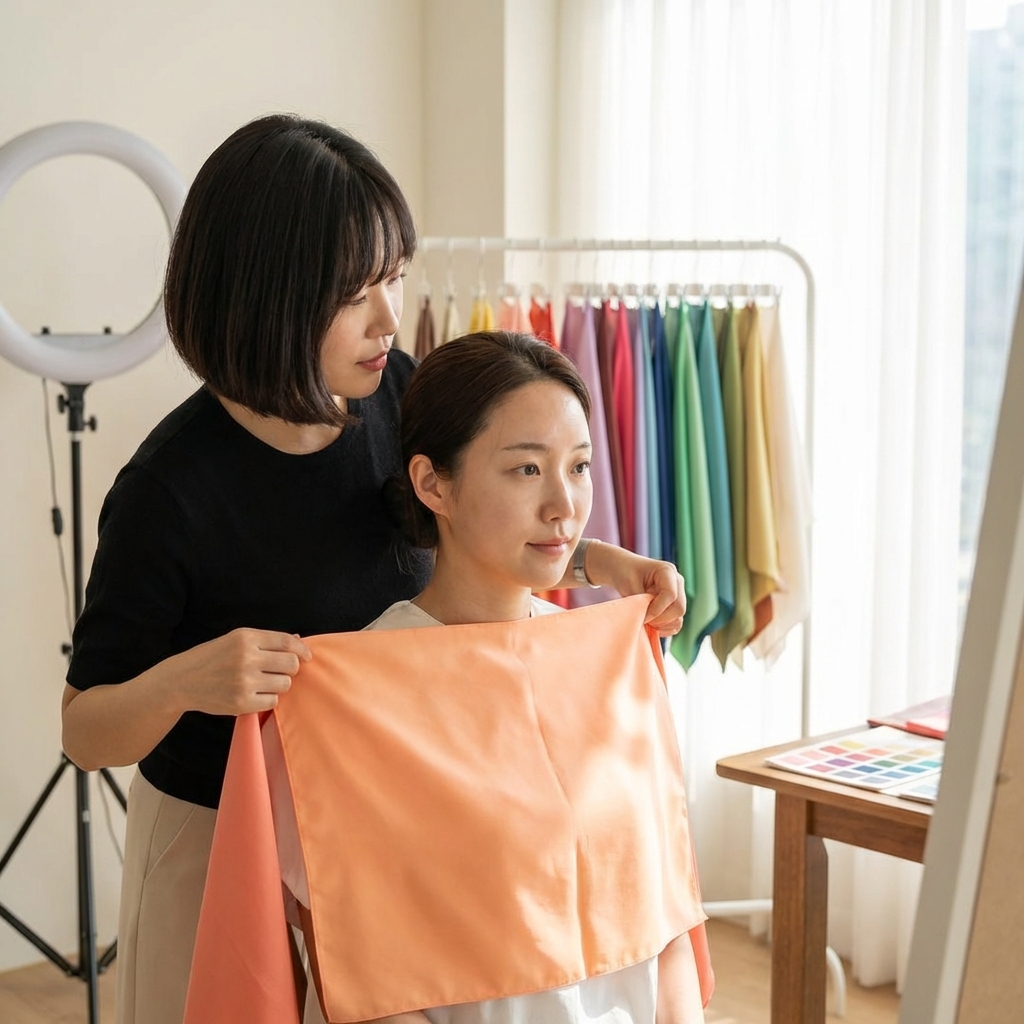
Step 2: The Draping (The Transformation)
This is the part you see on social media. You sit in front of a mirror under daylight-balanced lighting. The consultant systematically places colored fabric drapes under your chin. You will literally watch your face change with each drape—sometimes your chin line looks sharper; sometimes your under-eyes look darker.
Step 3: Pouch Analysis
One of the most valuable parts of the session. You bring your current makeup bag, and the consultant goes through every product—lipstick, eyeshadow, foundation—and tells you if it’s "Best," "Worst," or just "Okay" for your season.
[!IMPORTANT] Be prepared to be told that your favorite lipstick might not be your best shade! Many people find this part the most enlightening.
Step 4: The Final Verdict
You’ll receive a palette card (swatches), a list of recommended hair colors and jewelry (Gold? Silver? Rose Gold?), and a carefully curated list of K-beauty products to buy.
5. How to Prepare & Book
- The "No Makeup" Rule: You MUST arrive with a clean face. No foundation, no tinted moisturizer, and most importantly, no colored contact lenses. Your natural iris color is a key factor in the analysis.
- Booking: This is the hardest part. The top studios book out 1-2 months in advance. Use platforms like Creatrip, Klook, or Trazy to secure your spot as soon as your flights are booked.
- Price Range: Expect to pay between $80 USD (for a group session) and $200 USD (for a premium 1:1 session with a senior consultant).
6. Beyond the 4 Seasons: The 12-Tone & 16-Tone Systems
Many top Seoul studios now offer the 12-tone or 16-tone sub-typing system, which goes far beyond "you are a Spring." This is where the science gets genuinely sophisticated—and where the value for international visitors really spikes.
What's the Difference?
The 4-season system tells you whether you're warm/cool and bright/muted. The 12-tone system adds a third variable: depth (light, medium, or deep). This produces sub-categories like:
- True Spring vs Light Spring vs Bright Spring
- Soft Autumn vs Deep Autumn vs True Autumn
Why It Matters
The difference between a Light Spring and a True Spring might seem academic until you compare colors side-by-side. A Light Spring looks washed out in the vivid, saturated corals that a True Spring thrives in. Without the sub-type, you might be buying the wrong shade every single time.
The "Kibbe Body Type" Add-On
Many advanced studios in Seoul now offer a Kibbe Body Type analysis as an add-on (₩50,000–₩80,000 extra). This determines whether your ideal silhouette is "romantic," "dramatic," "natural," or one of several other archetypes, and translates directly into cut recommendations (fitted vs oversized, high waist vs low waist, etc.). Combined with personal color, this gives you a near-complete guide to dressing your specific body and complexion.
7. The 2026 Studio Pricing Guide
Prices have increased modestly in 2026 due to demand from international visitors. Here is a comprehensive breakdown.
| Session Type | Duration | Price Range (KRW) | Approx. USD | Notes |
|---|---|---|---|---|
| Basic 4-Season (Group) | 30–40 min | ₩70,000–₩90,000 | $53–$68 | 2–3 people at once; limited individual focus |
| Standard 4-Season (1:1) | 60–90 min | ₩120,000–₩200,000 | $90–$150 | Full draping + pouch analysis |
| Premium with Sub-Types | 90–120 min | ₩200,000–₩350,000 | $150–$265 | 12-tone or 16-tone sub-analysis |
| Master Consultant Session | 2+ hours | ₩350,000–₩500,000+ | $265–$377+ | Spectrophotometer + full PDF report |
| Kibbe Body Type Add-On | +30–45 min | ₩50,000–₩80,000 extra | $38–$60 | Usually bundled with premium sessions |
Pro Tip: Studios at Klook, Creatrip, or Trazy sometimes offer 10–15% discounts on standard sessions compared to booking directly. However, for premium or master-level sessions, book through the studio's official KakaoTalk channel to ensure you get the most experienced consultant.
8. The DIY At-Home Pre-Test
Before spending up to $265 on a studio session, do this quick at-home assessment to arrive with a hypothesis. Your consultant will confirm (or correct) it.
Step 1: The Vein Test (Undertone)
Look at your inner wrist in natural morning light (no LED):
- Green veins → Warm undertone (Spring or Autumn)
- Blue/purple veins → Cool undertone (Summer or Winter)
- Both equally → Neutral (could be True Spring or True Autumn)
Step 2: The Neutral Drape Test (Value & Chroma)
Hold a bright white piece of paper and a warm ivory/cream piece of paper next to your bare face (no makeup):
- If bright white looks clean and crisp against you → Likely Cool (Summer or Winter)
- If warm ivory looks more natural and flattering → Likely Warm (Spring or Autumn)
Step 3: The Jewellery Test (Warm vs Cool Confirmation)
- Gold makes you glow → Warm
- Silver makes you look sharper/cleaner → Cool
- Both work equally → Neutral
This three-step test gives you an 80% accurate preliminary result. Bring your hypothesis to your studio appointment to focus the session on sub-type refinement.
9. How to Use Your Results: A Post-Session Action Plan
Your palette card and PDF report are only valuable if you know how to apply them. Here is a practical 5-step action plan for the 48 hours after your session.
Step 1: Immediately — The Olive Young Filter
Walk directly to the nearest Olive Young with your palette card. Hold it up next to each lip tint and blush you're considering. Your consultant will have told you your "Best," "Okay," and "Avoid" color categories. Do not buy an "Avoid" shade, even if it's 1+1.
Step 2: Same Day — Hair Color Consultation
Your palette specifies which hair colors harmonize with your complexion. Most personal color consultants in Korea also provide hair color recommendations (e.g., "ash brown," "warm chestnut," "jet black"). If you're planning a haircut or color during your Seoul trip, bring the PDF report to your salon and show the hairdresser directly. Korean salons are extremely familiar with the personal color system and can translate your report into a precise dye formula.
Step 3: Week 1 — The Wardrobe Audit
At home, go through your closet and lay out your "Avoid" colors. These are the items that consistently make you look tired or dull—most people immediately recognize them when they compare against the palette. You don't have to throw them away, but stop reaching for them as standalone pieces.
Step 4: Week 2 — Online Shopping Filter
Use your season's key terms as filters on Korean shopping platforms. On Musinsa or 29CM, search:
- Spring Warm: "살구색" (apricot), "코랄" (coral), "피치" (peach)
- Summer Cool: "라벤더" (lavender), "로즈" (rose), "머브" (mauve)
- Autumn Warm: "테라코타" (terracotta), "카멜" (camel), "올리브" (olive)
- Winter Cool: "버건디" (burgundy), "에메랄드" (emerald), "네이비" (navy)
Step 5: Month 1 — Foundation & Concealer Match
Personal color also affects your foundation shade selection. Your consultant will have noted whether your skin looks better in a warm-undertone or cool-undertone base. Take this to any Olive Young beauty counter and ask for a foundation match using your specified undertone. In 2026, many Olive Young counters are equipped with foundation matching devices that scan your skin and recommend shades—but input your undertone category to narrow the results.
10. Frequently Asked Questions
Q: Can I get an accurate analysis if I have very dark or very light skin? A: Yes, absolutely. The Korean personal color system was designed to account for all skin tones, from very pale to very deep. In fact, consultants note that personal color differences are often more visible and impactful on deeper skin tones, because the contrast effects of harmonious vs disharmonious colors are stronger.
Q: What if my result surprises me? A: This happens often. Many people assume they are a warm tone because they tan easily, but turn out to be a "Light Summer Cool." The draping is scientific and objective—trust the process over your assumptions. The "surprise" result is also often the most transformative.
Q: Can men do personal color analysis? A: Absolutely. The studio Ocollor has a dedicated "Mr. Personal Color" package focusing on suits, ties, and shirt collar colors. All the major studios accommodate men, and the system applies identically regardless of gender.
Q: How long do the results last? A: Your personal color is determined by your genetics (skin melanin levels, eye color, hair color), so it is effectively permanent. The only thing that changes results over time is significant skin changes (e.g., serious illness, extreme weight change, or permanent hair dye that alters your perceived natural color). A session you do at 25 is still valid at 45.
Conclusion
Personal color analysis is more than just a makeover; it's a tool for confidence. Once you understand your palette, you stop wasting money on clothes you never wear and makeup that looks slightly "off." It's an investment in yourself that lasts a lifetime. In 2026, with studios now offering 16-tone sub-analysis and spectrophotometer precision, the accuracy has never been higher—making Seoul the best place in the world to get this done.
Think of the session not as a one-time event but as the first step in a long-term relationship with your own image. The average visitor who undergoes a personal color analysis in Seoul reports spending approximately 30% less on clothing within the following year—because they buy only what they know works, instead of impulsively reaching for colors that catch their eye but ultimately stay unworn. The ROI on a ₩150,000–₩200,000 session, measured against wasted spending on disharmonious clothes and makeup, is usually realized within the first few months. Go into the session curious, open-minded, and without attachment to your pre-conceived idea of "your color." The analysis will very likely confirm some things you already knew—and surprise you with at least one revelation that changes how you shop forever.
After your session, put the knowledge to work immediately with a haul at the nearest Olive Young — our Olive Young shopping hack shows how to time your visit for maximum savings. To understand which products from your season work best, our top 15 K-beauty cult favorites maps the icons by product type. And to build a full routine around your new palette, start with our 10-step Korean skincare guide.