Put Your Wallet Away: Why You Should Never Tip in Korea

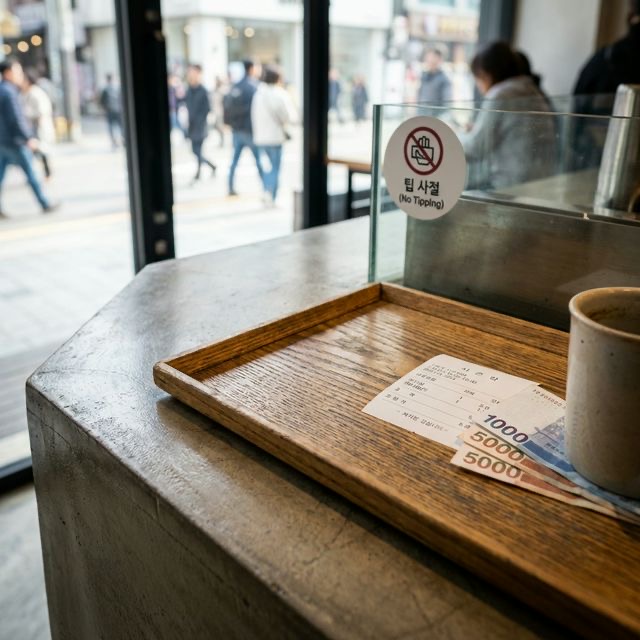
One of the least-discussed but most practically useful pieces of knowledge for visiting Korea is also one of the simplest: the price on the menu is the price you pay. Not the price before tax (tax is included). Not the price before service charge (service charges are not added). Not the price you pay before leaving a tip that is socially mandatory under pain of judgment. The menu price is the final price. This is not a trap, a cultural quirk to navigate around, or a system that secretly works differently than it looks — it is simply how payment works in Korea.
The simplicity is remarkable to visitors from countries where the real cost of a restaurant meal requires mental arithmetic at checkout. In Korea, that arithmetic does not exist. What does exist is a sophisticated payment culture with its own specific practices, etiquette, and occasional tech-related complications that are worth understanding before you arrive.
The No-Tipping Rule: What You Need to Know
Why Tipping Does Not Exist in Korea
Tipping is absent from Korean service culture not because wages are suppressed or because service workers earn less — Korean minimum wage is regulated and service jobs in restaurants and hotels generally pay competitive wages relative to the cost of living. The absence of tipping reflects a different cultural understanding of what service means.
In Korean service culture, providing excellent service is an inherent professional obligation, not something performed for additional financial incentive. A server who receives a tip may experience it as implying that their normal standard of service was insufficient and required reward — the opposite of the Western interpretation. Older workers in particular, who have spent careers in a non-tipping service culture, may react to a left-behind tip with confusion or mild offense.
The practical result: servers do not expect tips, do not check for tips, and will often return money left on a table assuming it was forgotten.
The Three Contexts Where This Applies
Restaurants and cafes: Do not leave change or any additional amount beyond the bill. There is no tip line on credit card receipts (with an important exception — see below). Walk out after paying. No awkward math, no social calculation.
Taxis: The taxi fare is metered. You pay the meter. If the fare comes to 9,700 KRW and you have a 10,000 KRW note, you can tell the driver to keep the change — this is tolerated as a rounding convenience, not as a gratuity, and is limited to small amounts. You are not expected to do this; most transactions are exact or via card.
Hotels: Hotel bellhops, concierge staff, and valet service are not tipped in Korean culture. At very high-end international hotels in Seoul (Josun, Shilla Bereau, Park Hyatt), international tipping norms have partially infiltrated due to significant Western business traveler volumes — this is the one context where tipping neither surprises nor offends. For domestic Korean hotels, guesthouses, and mid-range accommodations, no tip is expected or appropriate.
The Digital Kiosk Exception
A new and culturally contentious development: some newer cafes and restaurants with Western-style iPad ordering systems have added a tip prompt to their digital checkout flow. The options typically appear as "10%," "15%," "20%," or "No Tip."
Korean social media has had extensive discussions about this development, uniformly negative. The consensus is that the tip screen is a technology imported without cultural context, and locals essentially universally select "No Tip." Visitors can do the same with zero guilt — you are not violating any expectation, and many Koreans would thank you for supporting the cultural norm.
Digital Payments: The Card-Forward Society
Korea's transition to a cashless payment society is among the most complete in the world. Credit and debit card payment has been standard at Korean businesses since the 1990s — partly driven by government policy that incentivized card payments to reduce off-the-books cash transactions. The result is a country where card payment is expected everywhere, including at contexts where Western travelers often assume cash is necessary.
Credit and Debit Cards: Universal Coverage
Visa and Mastercard are accepted at virtually every retail location in Korea that has any payment terminal. This includes:
- All convenience stores (GS25, CU, 7-Eleven, emart24), including for 1,000 KRW purchases
- All chain restaurants and cafes (every Starbucks, McDonald's, Paris Baguette, Gong Cha, etc.)
- All department stores and shopping malls
- All KTX and intercity bus terminals
- Most mid-range and above restaurants
- All pharmacies (약국) and health product stores
- All taxis (via meter terminal or Kakao T in-app payment)
- Most jjimjilbang (sauna) and entertainment venues
Foreign transaction fees: Your home bank may charge a 1 to 3% foreign transaction fee on international card use. Cards marketed as "travel cards" (such as Chase Sapphire, Capital One Venture, or Charles Schwab Checking debit card) waive these fees. Using a fee-waiving card for all card transactions in Korea eliminates a meaningful cost over a week-long trip.
Apple Pay: Useful But Incomplete
Apple Pay reached Korea in 2023 after a long absence. Its coverage has expanded since launch but remains incomplete, particularly outside major chain locations. Current reliable Apple Pay acceptance:
Works consistently: McDonald's, Starbucks, GS25 (most branches), CU (most branches), Hyundai Department Store, select subway station ticket machines.
Does not work reliably: Most local Korean restaurants, small boutiques, traditional market stalls, most subway card reload machines, many jjimjilbang and public facility terminals.
Practical recommendation: Apple Pay is useful as a supplementary payment method for chain locations, but do not rely on it as your primary payment system. Always carry a physical card (Visa or Mastercard chip card) as backup. A transaction declined due to unsupported Apple Pay when you have no physical card is an avoidable frustration.
The WOWPASS Option for Tourists
WOWPASS is a prepaid debit card specifically designed for foreign visitors: you insert your home currency at orange WOWPASS kiosks (found at subway stations, airports, and hotels), it converts to KRW at a competitive rate, and the card functions as both a T-Money transit card and a Visa-network debit card at stores.
For visitors who want one card that covers transit taps, store purchases, and currency exchange in a single product, WOWPASS is the current best option. See the currency exchange guide for detailed WOWPASS comparison against other exchange methods.
When You Actually Need Cash
Korea's cashless infrastructure is impressive, but specific situations genuinely require physical KRW:
T-Money Card Reloads
The T-Money card (the blue transit card used on Seoul's subway and buses) can be reloaded at subway station machines and convenience store registers. The station machines accept only cash. Convenience store reloads via card are possible at some locations but inconsistent — the register may decline the card reload transaction depending on the store's system configuration.
Strategy: Keep enough cash on hand to reload your T-Money card (typically 10,000 to 30,000 KRW at a time, depending on your daily transit usage). This is the most consistent cash requirement of any Korea trip.
Street Food Vendors
The pojangmacha (orange tent stalls) selling tteokbokki, odeng, and twigim are the soul of Seoul street food culture. They are predominantly cash-only. Card acceptance has increased at some stalls in tourist-heavy areas (particularly Myeongdong), but at traditional markets and neighborhood stalls, cash is the standard. A stock of 1,000 KRW and 5,000 KRW bills is the correct preparation for street food day.
Traditional Markets and Small Vendors
Gwangjang Market's vintage arcade, Namdaemun's smaller stalls, and traditional markets across Korea operate primarily on cash. Additionally: cash payment at markets sometimes unlocks informal small discounts that card payment does not.
Rural and Remote Locations
Outside major cities and tourist infrastructure, card acceptance thins. Hiking trail entrance fees at rural temples, bus tickets in small cities, and small-town restaurants may be cash-only. If your itinerary includes significant travel outside Seoul and Busan, carry more cash accordingly.
Payment Etiquette: How Money Changes Hands
Korean social culture has specific norms around the physical act of handling money, and following them smoothly marks a visitor as attentive and respectful.
Two-Hand Receiving
When a cashier returns change to you, or when a vendor hands you merchandise or a receipt, receive it with two hands — right hand extended, left hand supporting the right forearm or wrist. This is the standard respectful receiving gesture in Korean culture and applies to all object exchanges, including credit cards, business cards, food, and drinks.
Giving: Similarly, when handing over cash or a credit card, use two hands or extend with your right hand supported at the forearm. Tossing money on the counter or handing it with a single extended arm is considered careless.
The Counter Tray
Many Korean cash register setups include a small plastic or lacquered tray on the counter. Money (both payment and change) is placed in the tray rather than handed directly person-to-person. The tray is a social buffer that maintains formal distance in commercial transactions. Place your cash in the tray; receive your change from the tray.
The Credit Card Dip
At restaurants, your card is typically taken to a separate terminal (Korean merchants rarely use wireless tableside card readers as standard). The server takes your card, processes it, and returns it with the receipt. This is normal practice and not a security concern — Korean card fraud rates are extremely low and the system is well-monitored. If you are uncomfortable with this, card-at-table terminals are increasingly available at higher-end restaurants upon request.
Splitting Bills: The Korean Dutch Pay System
For group dining situations, Korean bill-splitting practices differ from Western norms and are worth understanding.
"Dutch Pay" (더치페이) — The Peer Standard
Among Korean friends and acquaintances of similar social standing, splitting the bill equally (Dutch Pay) is the standard norm. The phrase "더치페이 해요" (deo-chi pe-i haeyo — "let's do Dutch Pay") signals this arrangement before ordering.
At the register: A group splitting the bill hands multiple credit cards to the cashier sequentially. This is completely normal — the cashier processes each card individually for the designated amount. If your Korean is minimal, simply say "따로따로" (ta-ro ta-ro — "separately") and hand over your card for your portion.
"Buying the Meal" — Hierarchical Social Contexts
In contexts involving different social hierarchies — a supervisor and employees, an older relative and younger family members, the person who extended an invitation — the social senior or the inviting party typically pays for the entire group. This is a Confucian social norm that remains very much active in Korean workplace and family contexts.
The ritual: The person paying will often move toward the register as dinner winds down, before the bill has been explicitly presented. Younger members of the party who attempt to pay when a clear social senior is present may be firmly redirected; genuine resistance is usually unnecessary and occasionally creates awkward social friction. Accept gracefully when you are being hosted.
The reciprocity expectation: If someone pays for a group meal today, there is an understanding that this will be reciprocated — not at the same meal, but across a relationship over time. Korean social relationships maintain a running informal ledger of this kind.
Tax: Always Included
Korea's 10% VAT is always incorporated into the displayed price. Menu prices, retail sticker prices, and quoted service fees are the actual final prices you pay. There is no separate line item for tax added at checkout.
The corollary — tax refunds: Because VAT is included in the price, foreign visitors are eligible to recover a portion of it upon departure. The immediate refund system (available at Olive Young, major department stores, and participating retailers) deducts this at the register; the airport claim system covers purchases from smaller retailers. See the full tax refund guide for the complete process.
Practical Money Summary
| Situation | Payment Method | Notes |
|---|---|---|
| Restaurant meal | Credit card | No tip, tax included in price |
| Convenience store | Card or Apple Pay | Cards universally accepted |
| Taxi | Card, Kakao T app, or cash | Card via in-taxi terminal |
| Subway transit | T-Money card | Reload with cash at station machines |
| Street food | Cash | Most stalls cash-only |
| Traditional markets | Cash preferred | Card sometimes possible at larger stalls |
| Major retail (Olive Young, Uniqlo) | Card, ask for tax refund | Show passport for immediate VAT deduction |
| Tipping | Never | Not culturally appropriate in any context |
2026 Price Updates: The Realistic Daily Budget
As of early 2026, Korea has seen a stabilization in transit and food pricing after the post-pandemic inflationary spike. While Korea remains excellent value compared to Tokyo, London, or New York, travelers should budget for these specific 2026 rates:
- Coffee (Americano): ₩2,500 (Mega Coffee/Paik's) to ₩5,500 (Specialty cafes in Seongsu/Hannam).
- Casual Lunch (Gimbap/Ramyun): ₩10,000–₩15,000 for a set meal.
- Mid-range Dinner (BBQ): ₩25,000–₩40,000 per person including drinks.
- Monthly Subway Pass: The Climate Card (monthly) is ₩62,000, but for tourists, the daily passes (₩5,000–₩15,000) remain the best value.
9. Common Scams and Pricing Traps to Avoid
While physical crime and outright theft are rare, specific pricing traps exist in tourist-heavy zones.
The "Service Fee" Lie
Occasionally, a restaurant in a heavy tourist area (like Myeongdong or near Palaces) might try to suggest that a 10% or 15% "Tourist Service Fee" is required for groups. This is illegal and non-standard. All taxes and fees must be included in the menu price by law. If you see this on a bill, point to the menu price and ask why it differs.
Call Van (Black Van) Taxis
At airports and major stations, you may see large black vans (not the official "Jumbo Taxis") offering fixed-rate rides. They often charge 3–4 times the metered rate. Always insist on the meter (기계 사용해 주세요 — gi-gye sa-yong-hae ju-se-yo) or use the Kakao T app to ensure a fair price.
No-Price Menus
Avoid any street stall or small restaurant that does not have clearly visible prices. While not always a scam, it opens the door for higher "foreigner pricing." Standard pojangmacha prices are almost always written on a cardboard sign or a small menu board.
10. Tips for Digital Nomads and Long-Stay Travelers
If you are staying in Korea for more than 30 days (perhaps on the Hallyu/Workcation visa), your payment needs change.
- Opening a Bank Account: Without an Alien Registration Card (ARC), it is nearly impossible to open a full Korean bank account. Digital nomads should rely on Revolut or Wise as primary cards, but consider a NAMANE Card or WOWPASS which functions as a local prepaid card with a dedicated app for balance tracking.
- ATM Withdrawals: Most Korean ATMs close at midnight. "Global ATMs" (identified by the large 'Global' sticker) in convenience stores are open 24/7 but have higher fees (₩3,500–₩5,000 per withdrawal). Use bank-affiliated ATMs during business hours for the lowest fees.
- KRW vs. USD on Terminals: Some terminals will ask if you want to pay in KRW or your home currency (USD/EUR). Always choose KRW. Choosing your home currency triggers "Dynamic Currency Conversion" (DCC), which uses a significantly worse exchange rate provided by the merchant's bank.
Conclusion
Korea is a country where the financial friction of travel has been almost entirely engineered away. The absence of tipping, the incorporation of tax into menu prices, and the near-universal acceptance of cards create a seamless experience for visitors. However, this convenience rests on a bedrock of local etiquette—receiving with two hands and respecting the "Dutch Pay" norm. By understanding these subtle cues and keeping a small amount of cash for the legendary street food stalls, you can move through the Korean economy with the confidence of a local.
Before you start your spending spree, make sure you have the essential apps to download before your trip so you can track your routes and payments effectively. To understand how to best allocate your budget, our ultimate 10-day South Korea itinerary provides cost estimates for different regions. And when you're ready to head back, our Incheon Airport guide will help you navigate the final tax refund kiosks and duty-free shops to wrap up your trip smoothly.
Travel smart, pay with respect, and enjoy the incredible value that Korea's sophisticated payment culture offers.