Traditional Market Shopping: Finding Gems in Gwangjang and Namdaemun

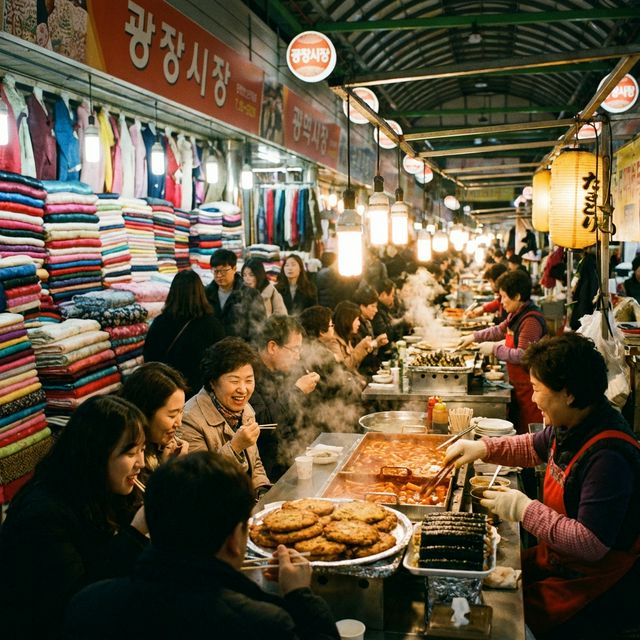
Most tourists visit Gwangjang Market for the Netflix-famous mung bean pancakes and Namdaemun Market as a checkbox stop for cheap souvenirs. Both experiences are real, but they represent the visible surface of two markets that have been the commercial heart of Seoul for over a century. Underneath the tourist layer are specialized sections that serve the actual working economy of the city — the fabric dealers who supply Korea's fashion industry, the restaurant equipment wholesalers who supply Seoul's kitchens, the jewelry manufacturers who supply boutiques across the country — and it is in these sections that the genuinely interesting shopping happens.
This guide is organized around what is actually worth finding in each market, with specific section navigation, practical logistics, and the food stops that make each market visit complete. It also covers the bargaining dynamics, Sunday closure issues, and the navigation tactics that prevent the usual tourist confusion.
Gwangjang Market (광장시장): The Textile and Vintage Capital
Getting there: Jongno 5-ga Subway Station (Lines 1 and 5), Exit 8. The main entrance is immediately visible from the exit. Operating hours are generally 9:00 a.m. to 6:00 p.m. for the main fabric and textile sections; the food stalls operate until later, typically 11:00 p.m.
The Famous Food Section (Ground Floor)
Before getting to the serious shopping, the food section needs acknowledgment because it is genuinely excellent and makes a strong first impression. The covered food hall on Gwangjang's ground floor contains dozens of stalls run by vendors who have been in the market for decades, serving food that has changed very little in that time.
Bindaetteok (빈대떡, Mung Bean Pancakes): The flagship Gwangjang food. Ground mung beans mixed with kimchi, pork, and bean sprouts, pan-fried in significant quantities of oil until crispy at the edges and dense in the center. Order a plate (5,000 to 8,000 KRW), request makgeolli (막걸리, milky rice wine, 3,000 to 5,000 KRW per bottle), and eat at the plastic stools provided. The combination of bindaetteok and makgeolli in a traditional market setting is one of the most Korean experiences available to visitors without leaving Seoul.
Mayak Gimbap (마약 김밥): Miniature seaweed rice rolls with pickled vegetables, served with a sharp yellow mustard dipping sauce. The name translates to "narcotic gimbap" — not because of actual narcotics, but because the dipping sauce creates genuine cravings. Find the women rolling tiny gimbap at high speed in the western end of the food hall.
Kalguksu (칼국수): Knife-cut noodles in a clear anchovy broth, thick and filling. Several stalls specialize in this alongside the more famous bindaetteok.
Food hall tactics: Sit at any stall and order. The vendors manage the space communally — it is acceptable to order bindaetteok from one vendor and makgeolli from a neighboring vendor and sit at the shared table. This is standard practice.
The Vintage Arcade (2nd Floor) — The Main Event
This is where Gwangjang transcends its tourist reputation and becomes a genuinely important destination for fashion-oriented visitors. Look for the small red signs reading "수입구제" (suip guje, imported vintage clothing) and follow them to the staircase near the market's eastern section. You emerge into a large, somewhat chaotic warehouse space filled with rack after rack of imported vintage clothing.
What you can find:
- Branded outerwear: Burberry trench coats, Barbour wax jackets, Woolrich parkas — these rotate through regularly and are typically dry-cleaned and in excellent condition
- Ralph Lauren knitwear: Polo and Rugby Ralph Lauren sweaters, often in wool or cashmere
- Carhartt workwear: Vintage American workwear (pre-2010 Carhartt is valued by collectors), often sourced from US estate sales
- Japanese denim: Levi's Japan, Edwin, and other Japanese denim labels from the 1980s and 1990s
- Military surplus: US Army field jackets, Korean Army items, European military clothing
- Sportswear: Vintage Nike, Adidas, and other athletic labels from the 1980s and 1990s
What the vintage arcade is not: It is not a charity shop with 2,000 KRW finds. Good pieces — a clean Burberry trench in appropriate size, a genuine vintage Levi's Type 1 jacket — run 40,000 to 150,000 KRW. You are paying for sourcing, dry cleaning, and the curation that keeps the quality high. Compared to what these pieces cost in vintage markets in New York or London, the pricing remains favorable.
Shopping approach: Allocate at least 90 minutes. The racks are organized loosely by category (outerwear, knitwear, bottoms) but the real finds come from systematic browsing. The shop owners are serious about their inventory — many are genuine vintage fashion enthusiasts — and will often provide sourcing information and styling suggestions if you express genuine interest.
Sizing reality check: Vintage sizing differs from contemporary sizing, and Japanese and Korean vintage markets tend to lean toward smaller Asian sizing conventions. Western visitors should anticipate sizing up and trying everything before purchasing. Alterations are available from tailors on the same floor and in adjacent Dongdaemun Market buildings.
The Fabric Section (1st Floor, Eastern and Northern Sections)
Gwangjang's historical identity is as a fabric market — it has been supplying fabric to Seoul's garment industry since 1905. The fabric section is still active and sells to both trade buyers and individual consumers.
What to buy as a visitor:
Hanbok silk fabrics: You will see long tables and rack displays of brilliant, vivid fabrics in traditional Korean colors — deep blue (cheongsaek), red (juhong), and the combination palettes used for hanbok garments. Buying fabric as a souvenir — a meter or two of a particularly beautiful silk or ramie cloth — is an excellent alternative to buying mass-produced tourist items. A meter of decent quality hanbok fabric runs 15,000 to 40,000 KRW.
Bojagi (보자기, wrapping cloths): The traditional Korean wrapping cloth is a large square of fabric used for carrying, wrapping, and presenting objects. Bojagi in traditional silk or ramie with hand-stitched embroidery or patchwork patterns are sold throughout the fabric section and make beautiful, light, practical souvenirs that pack flat.
Korean blankets (밍크 담요, mink blankets): Korea's famous "mink blankets" are not actually mink — they are very high-quality microfiber with a dense, velvety pile that creates extraordinary softness. Stall #156 "Assibang" (아씨방) has become well-known specifically because they offer vacuum compression packing: a full king-sized blanket compressed to a small cube by a machine in the shop, allowing it to be carried in check-in luggage. These blankets typically cost 30,000 to 80,000 KRW and remain some of the most beloved practical purchases visitors make in Korea.
Namdaemun Market (남대문 시장): The Everything Store
Namdaemun (literally "Great South Gate") is the oldest market in Seoul, tracing its history to the 14th century, and today it is a sprawling complex of over 10,000 stalls across multiple buildings and outdoor sections. The sheer scale is intimidating, but the market is organized into specialist sections by building, and knowing which building serves which category eliminates most of the confusion.
Getting there: Hoehyeon Subway Station (Line 4), Exit 5. The market spreads in multiple directions from the station exit. The main gate and central area are immediately visible. Operating hours are roughly 10:00 a.m. to 6:00 p.m. for most sections; the market is largely closed on Sundays.
D-Dong Building: Kitchenware and Restaurant Equipment
Building D (D동) is the restaurant supply section of Namdaemun — where Seoul's professional kitchen operators come for equipment. The products here are restaurant-grade, Korean-made, and priced at wholesale-adjacent levels.
What to buy:
Stone bowls (돌솥, dolsot): The heavy volcanic stone bowls used for serving dolsot bibimbap and other Korean dishes that require table-side cooking. A genuine dolsot from Namdaemun is a fraction of what the same item costs at kitchenware retailers in Western countries. Sizes run from individual to family; prices from 8,000 to 25,000 KRW depending on size and quality.
Brass and lacquer chopsticks: Korean chopsticks are flat-ended metal rather than round-ended wood — a distinct national tradition. A set of quality brass or stainless steel chopsticks from Namdaemun costs 3,000 to 15,000 KRW and is a functional, culturally specific souvenir that Korean friends and family receive enthusiastically.
Large ramen pots (라면 냄비): The classic Korean instant ramen pot — a thin aluminum pot with a fitted lid, designed for the exact water volume and heat distribution that produces properly cooked ramen on a gas burner. These are not available at Western kitchenware stores and are genuinely useful for anyone who cooks Korean-style noodles at home. Price: 5,000 to 15,000 KRW.
Cast iron and ceramic cookware: Korean ceramic cookware — the glazed onggi pots used for kimchi fermentation, the ceramic casseroles used for jiigae — is available from multiple vendors in this section. Quality varies; the better pieces come from specific regional workshops that vendors will identify if asked.
The Accessories Wholesale District
Namdaemun supplies costume jewelry, hair accessories, and fashion accessories to boutiques across Korea and internationally. The prices reflect the wholesale structure — far below retail in most other contexts.
What to buy:
Earrings and necklaces: Simple stainless steel jewelry, demi-fine pieces, and fashion-forward designs reflecting current Korean trend cycles. Prices range from 2,000 KRW for simple stud earrings to 15,000 to 30,000 KRW for more elaborate pieces.
Hair accessories: The market is excellent for the specific hair accessories that cycle through Korean fashion trends — fabric-covered hair ties, decorative pins, headbands in specific textures. Korean hair accessories have had significant Western fashion influence in recent years.
Note on wholesale shops: Some stalls display signs reading "도매" (do-mae, wholesale only). These stalls typically require minimum quantity purchases (12 or 24 pieces of an item). Other stalls happily sell single items to individual customers. The signs are usually in Korean, so asking "하나 살 수 있어요?" (hana sal su isseoyo? — "can I buy just one?") clarifies whether walk-in single-purchase is possible.
Children's Clothing Section
An entire street within Namdaemun is dedicated to children's clothing — Korean kids' fashion at prices significantly below major international children's brands. The quality is genuinely good: Korean children's clothing tends toward natural fiber content, careful construction, and designs that are both fashionable and practical.
If shopping for children, arrive in the morning when the selection is fullest and the vendors have energy for the inevitable size questions.
Glasses and Contact Lens District
Namdaemun has a cluster of optical shops offering a complete service: eye examination, prescription verification, frame selection, and lens cutting within 30 to 60 minutes. The total cost for prescription glasses (frame + lenses) in the mid-range runs 30,000 to 80,000 KRW — significantly below comparable service in the US or most European countries.
This is a practical stop for visitors who need new glasses or spare pairs, or who want to purchase Korean-designed frames (which tend toward thinner, more architectural styles than are common in Western markets) at Korean retail prices.
Bring: Your current prescription or spare pair from which they can measure your current prescription.
Shopping Tactics for Both Markets
The Bargaining Question
Korean traditional markets have a different bargaining culture than Southeast Asian markets. Prices are generally not openly negotiable in the way that aggressive bargaining is expected at Thai or Vietnamese markets. However:
Acceptable: Politely asking "좀 깎아줄 수 있어요?" (jom kka-kka-jul su isseoyo? — "Can you lower the price a little?") for items where you are purchasing multiple pieces or where the item has minor imperfections. Vendors often will; they often won't. Either outcome is fine.
Not acceptable: Aggressive lowballing, making insulting offers, or persistent pressure after a polite refusal. "이거 너무 비싸요" (igeo neomu bissayo — "This is too expensive") followed by walking away is acceptable and sometimes results in the vendor calling you back with a better price. This is genuine market behavior, not a performance.
The cash advantage: Many traditional market vendors prefer cash. Offering cash payment when cards are also accepted sometimes unlocks a small informal discount (3 to 10% on larger purchases), particularly at the vintage arcade where individual vendors have more pricing flexibility than chain retailers.
Sunday and Holiday Closures
Namdaemun Market is largely closed on Sundays — the fabric, clothing, and equipment sections are shuttered. The food stalls near the main entrance operate, but the shopping is minimal. Do not plan a Namdaemun shopping day on Sunday.
Gwangjang Market is more varied: the food hall operates daily, and the vintage section often opens on Sundays (11:00 a.m. to 7:00 p.m.). The fabric and textile sections at Gwangjang follow more traditional Tuesday-to-Sunday schedules, with some vendors closing Monday. Verify specific sections before visiting.
Public holidays: Both markets have reduced operation during the major Korean holidays (Chuseok, Seollal). Check dates and plan to visit at least a day or two before or after the holiday cluster.
Navigation Basics
Namdaemun's buildings are color-coded and lettered (A-dong through H-dong and more). When you find a section you want to return to, photograph the building signage and the nearest landmark. The inside of Namdaemun is easy to get turned around in, and "I'm near the accessories section" is not sufficient navigation information for later.
Gwangjang's vintage arcade has no formal address within the market. Landmark it by: northeast section, second floor, accessible via the interior staircase near the Korean fabric and silk section. Once you have been once, the entry staircase is recognizable.
5. 2026 Innovation: The Smart Market Revolution
By 2026, the historical charm of Seoul’s markets has been bolstered by cutting-edge technology designed to bridge the gap between traditional vendors and international travelers.
The Gwangjang "AR Path" App
Navigating the labyrinthine second floor of Gwangjang’s vintage arcade was once a rite of passage based on luck. In 2026, the Gwangjang AR Navigation App (available at the entrance via QR code) allows you to "see" through walls.
- How it works: Hold up your phone, and the app overlays the names of shops, their specialties (e.g., "1990s Denim," "Italian Leather"), and their current "Hot Deal" items.
- AI Translation Hubs: If you find a fabric you love but the vendor speaks only Korean, look for the "Smart Pillars" scattered throughout the fabric section. These are AI-powered translation screens where you can speak in English, and the vendor can hear the translation in real-time through their wearable headset.
NFC-Enabled "Smart Bojagi"
The traditional wrapping cloth (Bojagi) has received a high-tech upgrade. In 2026, premium Bojagi shops in Gwangjang offer NFC-Embedded Labels.
- The Feature: You can record a video message or a digital "How-To-Wrap" guide on your phone and link it to the small NFC chip inside the cloth's hem. When the recipient scans the cloth with their phone, your message pops up, making it the ultimate 2026 personalized souvenir.
6. Sustainability: Upcycling and Zero-Waste Stalls
In response to global environmental trends, Seoul’s traditional markets have become surprising leaders in the "Circular Economy" by 2026.
The Gwangjang Upcycling Hub
The vintage arcade on the second floor has expanded to include a dedicated Upcycling Zone. Here, young Korean designers take damaged vintage luxury items (like a stained Burberry trench or a torn Ralph Lauren sweater) and reconstruct them into "One-of-a-Kind" (OOAK) pieces—bags made from vintage denim, or hats made from old silk Hanboks.
- Why it matters: These pieces are highly coveted by the "MZ Generation" in Korea, often selling for more than the original vintage item due to their unique artistic value.
Zero-Waste Street Food
Myeongdong’s street food is often criticized for its plastic waste, but Gwangjang and Namdaemun have pivoted to Multi-Use Tray Systems in 2026.
- The System: When you buy Bindaetteok, it is served on a high-quality, reusable stainless steel tray. After eating, you return it to a "Smart Collection Bin" that uses steam sterilization. Fans of the markets appreciate this return to a more "original" and less wasteful mode of eating.
7. The Night Owl’s Secret: Namdaemun’s Midnight Wholesale
While the "Day Market" in Namdaemun is for tourists and casual shoppers, the Midnight Wholesale Market (11:00 PM to 4:00 AM) is where the real commercial energy lies in 2026.
- The Accessories Rush: This is when boutique owners from across Asia arrive to buy costume jewelry and hair accessories in bulk. In 2026, the vibe is electric—thousands of people moving through narrow aisles under bright LED lights, the smell of coffee and spicy snacks thick in the air.
- Individual Access: While most shops are wholesale-only (Do-mae), several buildings in the C and D blocks have 2026-designated "Retail Friendly" zones during the night hours, where you can buy single items at near-wholesale prices if you pay with WowPass or cash. It’s the best kept secret for travelers suffering from jet lag.
8. Final Thoughts on Market Culture
The traditional markets of Seoul have survived and thrived for centuries because of their incredible ability to adapt. In 2026, the arrival of AR navigation, NFC-enabled Bojagi, and zero-waste initiatives has only enhanced the experience for international travelers without diluting the raw, energetic soul of the market aisles. Whether you are hunting for vintage denim in Gwangjang or exploring the midnight wholesale accessory rush in Namdaemun, you are witnessing the heartbeat of Korean commerce.
Don't be afraid of the labyrinthine alleys—embrace the chaos, eat at the shared tables, and take home a piece of history that has been reimagined for the 21st century.
For the broader market overview, pair this with the ultimate guide to traditional Korean markets and what to buy. If you want the opposite end of the shopping spectrum, compare it with the Seongsu-dong shopping guide or the Gangnam luxury fashion districts guide. And if you expect to buy clothes while moving between those areas, keep the Korean clothing sizing guide ready before you bargain or try anything on.