Best Children's Museums and Science Parks in Seoul

Quick Navigation
- Part of the Family Travel in Korea series.
Introduction: Why Seoul is a Paradise for Young Explorers
If you’ve ever wandered the bustling streets of Myeongdong or stood in awe beneath the neon glow of Gangnam, you know that Seoul is a city of high-octane energy and cutting-edge innovation. But for families traveling with children, there’s a whole different side to the South Korean capital that often goes unsung—a world where science, history, and pure, unadulterated play collide.
Seoul is, quite simply, one of the most family-friendly cities on the planet. From the ubiquitous nursing rooms (suyu-sil) in subway stations to the meticulously maintained parks, the infrastructure is built with little ones in mind. But it’s the city’s commitment to education—what locals call gyo-yuk—that truly shines in its world-class museums and science parks. These aren't just places to escape a rainy afternoon; they are immersive hubs designed to spark curiosity, nurture creativity, and provide hands-on learning experiences that rival any in the world.
Whether your child is a budding astronaut, a mini-archaeologist, or just has a lot of energy to burn, Seoul’s array of children’s museums and science centers offers something for every age and interest. In this guide, we’re going to dive deep into the very best spots that promise to make your family trip to Korea both educational and unforgettable.
1. Seoul Children’s Museum (Gwangjin-gu): The Gold Standard of Interactive Play
If you only have time for one "kid-centric" museum in Seoul, the Seoul Children’s Museum (Seoul Sangsang Nara) should be at the top of your list. Located within the sprawling greenery of Seoul Children’s Grand Park, this museum is a four-story wonderland that perfectly balances "learning" and "playing."
The Four-Floor Experience
Unlike traditional museums where the rule is "look but don't touch," here, the rule is "touch everything." The museum is divided into several thematic zones:
- 1st Floor (Sensory & Artistic Discovery): This floor focuses on art and expression. Children can experiment with digital art, light play, and tactile installations. It’s a great way to let them settle in and start exploring their creative side.
- 2nd Floor (Physical & Creative Play): Here, kids can engage in more active play. There are climbing structures, interactive games that require movement, and zones that encourage imaginative thinking through construction and building blocks.
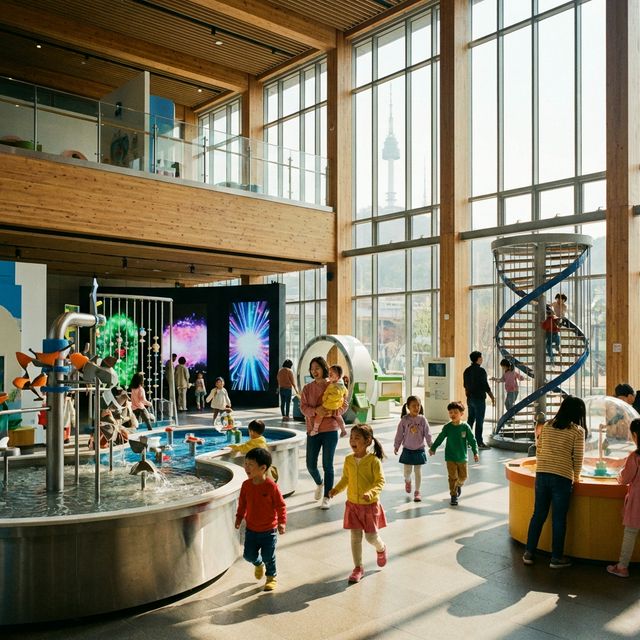
- 3rd Floor (Science & Culture): This is often the highlight for many kids. It features an incredible Water Play Zone where children can manipulate water flows, build dams, and learn about fluid dynamics (don't worry, aprons are provided!). There’s also a cultural section that introduces kids to global lifestyles and traditions in a fun, accessible way.
- Basement (Science Park): The basement level often hosts rotating special exhibitions that are just as high-quality as the permanent ones, often focusing on eco-friendly living or future technologies.
Why It’s Special
What sets the Seoul Children's Museum apart is the sheer quality of the exhibits. They aren't just plastic toys; they are well-engineered interactive displays that genuinely teach concepts like gravity, light refraction, and social cooperation. The museum is also incredibly spacious, meaning even on busy days, children have room to explore without feeling overwhelmed.
Practical Tips for Parents
- Reservations are Key: This museum is extremely popular with local families. While walk-ins are sometimes possible, it’s highly recommended to book your time slot in advance via the official website (which has an English interface) or Naver.
- Pair it with the Grand Park: Since you’re already at Seoul Children’s Grand Park, make a day of it. The park itself features a free zoo, botanical gardens, and several large outdoor playgrounds.
- Age Range: Best for children aged 3 to 10.
- Location: 216 Neungdong-ro, Gwangjin-gu, Seoul (Line 7, Children's Grand Park Station, Exit 1).
2. Gwacheon National Science Museum: The Mega-Scale Adventure
While technically located just across the city line in Gyeonggi-do, the Gwacheon National Science Museum is so easily accessible by the Seoul Subway (Line 4) that it is a must-include for any science-loving family. This is the "big one"—a massive complex that spans both indoor and outdoor spaces, designed to make science feel like a grand adventure.
A Journey Through Time and Space
The museum is organized into several massive halls, each with a specific focus:
- Natural History Hall: This is a fan favorite for dinosaur enthusiasts. It features massive fossil reconstructions, life-sized animatronics, and interactive displays that explain the evolution of life on Earth. The sheer scale of the Hall is enough to leave kids wide-eyed.
- Space & Future Hall: If your child dreams of being an astronaut, this is their haven. You’ll find models of Korean rockets (like the Nuri), simulators that mimic the feeling of weightlessness, and detailed exhibits about the history of space exploration and the future of smart cities.
- Basic Science Hall: Here, the complex laws of physics and chemistry are broken down into fun, hands-on experiments. Kids can generate electricity, learn about centrifugal force, and see giant Tesla coils in action.
- Insectarium & Biodiversity: Don't miss the separate insectarium building, where children can see everything from giant beetles to beautiful butterflies in a climate-controlled greenhouse.
Outdoor Wonders: The Dinosaur Park
One of the unique features of Gwacheon is its massive outdoor area. There is a Dinosaur Park with life-sized statues, a miniature steam train that kids can ride, and a massive playground that integrates scientific principles into the equipment. In the summer, there are often water-based exhibits, and in the fall, the park is a beautiful spot for a family picnic.
Why It’s Special
The sheer variety is unmatched. Whether your child is 5 or 15, there is something that will genuinely interest them. For older kids, the depth of scientific information is impressive, while younger kids will simply enjoy the tactile nature of the displays.
Practical Tips
- Give it a Full Day: You cannot see this museum in two hours. Plan to spend at least 4-5 hours here, especially if you want to explore the outdoor park.
- Check the Planetarium Schedule: The museum has a state-of-the-art planetarium. Shows often sell out, so check the schedule as soon as you arrive.
- Location: 110 Sanghabeol-ro, Gwacheon-si, Gyeonggi-do (Line 4, Seoul Grand Park Station, Exit 6).
3. National Children’s Science Center (Jongno-gu): Science Meets History
Located in the heart of historic Seoul, right next to the beautiful Changgyeonggung Palace, the National Children’s Science Center is a gem that many tourists overlook. It was renovated a few years ago and turned into a dedicated space specifically for younger children (preschool to early elementary).
Sensory, Imagination, and Creation
The center is divided into three main "Science Playgrounds":
- Sensory Playground: Aimed at the youngest visitors, this zone focuses on light, sound, and touch. It’s colorful, safe, and highly engaging for toddlers who are just starting to discover the world.
- Imagination Playground: This floor features more complex interactive machines. Children can learn about gear systems, pulleys, and the "Rube Goldberg" style of cause-and-effect through massive ball-run installations.
- Creative Playground: This area is focused on DIY and building. There are workshops where kids can assemble simple robots or work with 3D printers (under supervision).
The Perfect Location
What makes this center particularly attractive for travelers is its location. Since it's in Jongno, you can easily combine a morning visit here with an afternoon tour of Changgyeonggung Palace or the Bukchon Hanok Village. It provides the perfect "kid-friendly" break in a day otherwise filled with traditional sightseeing.
Practical Tips
- Naver Reservations: Like the Gwangjin museum, this one almost always requires a reservation. It’s a bit smaller than the others, so slots fill up quickly on weekends.
- Combine with the Palace: There is a small gate that connects the museum grounds to the palace area, making for a very smooth transition.
- Age Range: Best for children aged 4 to 12.
- Location: 215 Changgyeonggung-ro, Jongno-gu, Seoul (Line 4, Hyehwa Station, Exit 4).
4. Seoul Science Center (Nowon-gu): For the Future Scientists
If your children are slightly older (late elementary to middle school) and are looking for something a bit more challenging, head north to the Seoul Science Center in Nowon-gu. Opened in 2017, this center feels incredibly modern and focuses heavily on the "application" of science in our daily lives.
The Four Color-Coded Halls
The exhibits are organized into four main halls, each designated by a color:
- Red (Survival): Focuses on energy, climate change, and how humans survive in changing environments.
- Orange (Connection): Explores the world of telecommunications, networks, and the internet—very fitting for a city as hyper-connected as Seoul!
- Blue (Life): Dives into biology, from the microscopic world of cells to the complex systems of the human body.
- Green (Circulation): Focuses on the ecosystem of Seoul and the Han River, teaching kids about urban ecology and sustainability.
High-Tech Learning
The Seoul Science Center prides itself on using technology to teach. You’ll find plenty of VR (Virtual Reality) experiences, interactive digital walls, and simulations that are sophisticated enough to engage even the most tech-savvy teenager. The library here is also exceptional, filled with science-themed books and quiet corners to read.
Why It’s Special
It feels less like a "playroom" and more like a "laboratory." It encourages critical thinking and asks kids to solve problems rather than just push buttons. If you have a child who is genuinely curious about how things work, this is the place to go.
Practical Tips
- Check the Workshops: They offer fantastic science-making workshops (though many are in Korean, the hands-on nature makes them accessible for foreigners too).
- Cafeteria and Rest: There’s a nice cafe on-site with views of the surrounding hills.
5. National Museum of Korea (Children's Museum): Stepping Back in Time
In the heart of Yongsan, the National Museum of Korea isn't just for adults. Its dedicated Children's Museum is a masterpiece of historical storytelling through play.
- The Theme: The museum uses traditional folk tales and ancient artifacts to teach history. In 2026, the main theme is "The Life of a Royal Child," where kids can dress in virtual Hanboks and participate in a digital royal banquet.
- Hands-On Archaeology: There is a large sandbox area where children can "excavate" replica pottery shards and learn how historians piece together the past.
- 2026 Edge: The museum now features "Living History" AR glasses, allowing kids to see the monumental 10-story pagoda in its original vibrant colors through augmented reality.
- Location: 137 Seobinggo-ro, Yongsan-gu (Line 4 / Jungang Line, Ichon Station).
6. Seoul Robot & AI Museum ( 도봉구 ): The Future is Now
Newly opened and fully reaching its peak in 2026, the Seoul Robot & AI Museum (RAIM) in Chang-dong is a glimpse into 22nd-century Seoul.
- Unique Entry: The building itself was partially constructed by robots. The globular, futuristic architecture is a sight to behold before you even enter.
- Interacting with AI: Children can engage in "Logic Battles" with AI systems, learn how to code basic robotic movements, and watch a "Robot Symphony" where mechanical arms play traditional Korean instruments.
- The "Mecha" Experience: There is a dedicated zone where kids can pilot miniature drones and remote-controlled rovers through a simulated Mars landscape.
- Location: 1277-2, Chang-dong, Dobong-gu (Line 1/4, Chang-dong Station).
7. Gyeonggi Children's Museum (Yongin): Worth the Day Trip
If you are willing to venture 40 minutes south of Seoul to Yongin (near Everland), the Gyeonggi Children's Museum is widely considered the most advanced facility of its kind in the nation.
- The "Nature" Focus: While Seoul's museums are high-tech, Gyeonggi’s focuses on "Eco-Life." It features a massive indoor tree called the "Global Tree" that children can climb to learn about biodiversity.
- The Construction Zone: A massive favorite where kids wear hard hats and neon vests to build "houses" using foam bricks and pulleys.
- Cultural Diversity: A dedicated gallery explores the lives of children from diverse multicultural families in Korea, fostering empathy and global awareness.
- Location: 6 Sanggal-ro, Giheung-gu, Yongin-si (Suin-Bundang Line, Sanggal Station).
📊 Summary: Choosing the Right Spot for Your Family
| Museum | Best For... | Age Range | Duration |
|---|---|---|---|
| Seoul Children's Museum | All-around interactive play | 3–10 | 3+ hours |
| Gwacheon Science | Space, Dinosaurs & Scale | 5–15 | Full Day |
| National Children's Science | Sensory play & Central location | 2–8 | 2 hours |
| Seoul Science Center | Teens / Deep Tech | 10–18 | 3 hours |
| Robot & AI Museum | Coding & Future Tech | 7–15 | 3 hours |
| National History Child | Cultural history / Hanboks | 4–10 | 2 hours |
💡 Practical Hacks for a Smooth Visit (2026 Edition)
- The "Sangsang" Pass: In 2026, the Seoul City Government introduced a unified digital pass for these museums. If you plan to visit more than three, buy the Seoul Family Fun Pass on the "Visit Seoul" app to save 40% on total entry fees.
- Stroller Access: Every museum on this list is 100% stroller-accessible with elevators and ramps. Most offer free stroller rentals (Yoo-mo-cha) at the entrance—just bring your passport as collateral.
- The "Lunchbox" Culture: Many of these centers have "Urban Picnic" zones where you can eat your own food. This is a great way to save money and cater to picky eaters. Grab some Gimbap at a nearby Gimbap Cheonguk before you enter.
- Visit on Weekdays: If your schedule allows, visit on a Tuesday or Wednesday morning. Saturday and Sunday are "peak family time" in Korea, and these museums become incredibly crowded with local families.
❓ 2026 Family Travel FAQ
Q: Are these museums open on Mondays? A: Most public museums in Seoul (like Seoul Children’s Museum and the National Science Center) are closed on Mondays. Always check the Naver Map or the official website before heading out.
Q: Are there places to rest for parents? A: Yes! Every museum on this list has a dedicated cafe or resting lounge. In 2026, many have added "Quiet Zones" for parents to recharge while kids play in enclosed, supervised areas.
Q: Is there food available on-site? A: Yes, all major centers have cafeterias (Sik-dang) serving kid-friendly meals like Tonkatsu (pork cutlet), Omurice, and Udon. Expect to pay around ₩9,000–₩13,000 per meal.
Q: Is English signage good enough? A: At the Seoul Children’s Museum and Gwacheon Science Museum, English signage is excellent. At smaller local centers, it can be sparse, but the exhibits are so tactile that kids usually don't need to read to understand how things work.
Conclusion: Seoul’s Science Scene is World-Class
Seoul’s investment in children’s education is evident in these extraordinary venues. Whether your family spends a morning at the hands-on Seoul Children’s Museum or a full day at the mega-scale Gwacheon National Science Museum, you’ll leave with tired legs and wide-eyed kids full of questions.
Once their brains are full and it's time to unleash some pure adrenaline, plan an adventure to the Best Theme Parks in South Korea: Everland, Lotte World and Beyond. For those mapping out their entire trip, our masterclass on Family Travel in South Korea: Best Kid-Friendly Destinations and Tips is a great companion read. And if you have younger siblings in tow, you'll want to review Korea with Toddlers: Practical Tips for Traveling with Young Children to ensure every museum visit goes smoothly.