UNESCO World Heritage Sites in South Korea You Must See
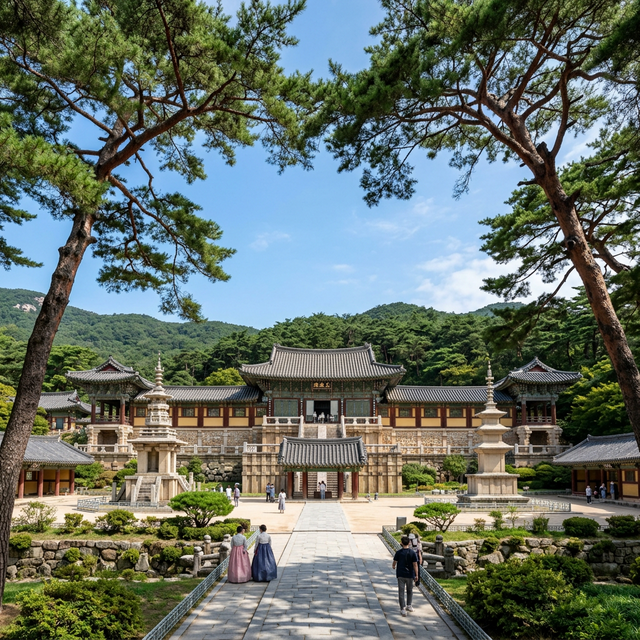
South Korea has 16 UNESCO World Heritage Sites — more per capita than most countries in the world, and spanning a range from 5,000-year-old dolmen fields to a 13th-century collection of 81,000 hand-carved Buddhist scripture woodblocks that somehow survived seven centuries without decay. This guide covers the most visitor-accessible sites and explains what makes each one worth the journey.
South Korea's UNESCO World Heritage Sites: Overview
South Korea's 16 UNESCO-designated sites were inscribed between 1995 and 2025, covering cultural, natural, and mixed heritage:
| Year | Site |
|---|---|
| 1995 | Seokguram Grotto and Bulguksa Temple |
| 1995 | Haeinsa Temple Janggyeong Panjeon (Tripitaka Koreana) |
| 1995 | Jongmyo Shrine |
| 1997 | Changdeokgung Palace Complex |
| 1997 | Hwaseong Fortress, Suwon |
| 2000 | Gyeongju Historic Areas |
| 2000 | Gochang, Hwasun and Ganghwa Dolmen Sites |
| 2007 | Jeju Volcanic Island and Lava Tubes |
| 2009 | Royal Tombs of the Joseon Dynasty |
| 2010 | Historic Villages of Korea: Hahoe and Yangdong |
| 2014 | Namhansanseong |
| 2015 | Baekje Historic Areas |
| 2018 | Sansa, Buddhist Mountain Monasteries in Korea |
| 2019 | Seowon, Korean Neo-Confucian Academies |
| 2021 | Getbol, Korean Tidal Flats |
| 2023 | Gaya Tumuli |
This guide focuses on the most traveled and accessible sites for international visitors.
1. Gyeongju Historic Areas (2000) — "The Museum Without Walls"
Location: Gyeongju, North Gyeongsang Province (2.5 hours from Seoul by KTX)
The ancient capital of the Silla Kingdom (57 BCE – 935 CE) is often described as the largest outdoor museum in the world, and the description doesn't feel like hyperbole when you're there. The Gyeongju Historic Area is not a single site but a landscape — an entire city whose surroundings are defined by royal burial mounds, temple ruins, and ancient archaeological zones.
The four main zones:
- Mount Namsan Belt: Buddhist carvings, pagodas, and temple ruins scattered across the slopes of the holy mountain
- Wolseong Belt: The ancient palace site, including the famous Donggung Palace and Wolji Pond (Anapji) — especially beautiful at night when the pavilions reflect in the water
- Tumuli Park Belt: The royal burial mounds; enormous grass tumuli containing gold crowns, jewelry, and ceramic treasures (some excavated, artifacts now at Gyeongju National Museum)
- Hwangnyongsa Temple Site: The excavated footprint of what was once Asia's largest wooden temple (destroyed by the Mongol invasion, 1238)
Also essential:
- Bulguksa Temple (UNESCO) — the most complete surviving expression of Silla Buddhist architecture; terraced stone platforms, two famous pagodas (Dabotap and Seokgatap), and extraordinary bronze Buddhas
- Seokguram Grotto (UNESCO) — a granite cave housing a 4th-century stone Buddha of mathematical perfection, surveying the East Sea through the mountains; one of the most spiritually powerful sites in Asia
- Cheomseongdae Observatory — the oldest surviving astronomical observatory in East Asia (7th century CE); a modest and perfect stone cylinder
How to get there: KTX from Seoul to Singyeongju Station (~2 hrs 15 min); local bus or taxi for the sites.
How long to plan: Minimum 2 days; ideally 3 to see both Gyeongju city sites and Bulguksa/Seokguram.
2. Haeinsa Temple Janggyeong Panjeon (1995) — 81,000 Wooden Scriptures
Location: Gayasan National Park, South Gyeongsang Province (~3 hours from Seoul)
This is one of the most extraordinary human achievements in all of East Asia.
During the Goryeo dynasty (13th century), with the Mongol invasion imminent, Korean Buddhist monks undertook one of history's most ambitious cultural preservation projects: hand-carving the complete Buddhist Tripitaka (the canon of Buddhist scripture) onto 81,258 wooden printing blocks — a project that took 16 years and produced a collection so comprehensive it remains the most complete and accurate version of the Tripitaka in the world.
These woodblocks have survived 700+ years without significant decay, housed in four wooden buildings (Janggyeong Panjeon) whose design includes the world's first known systematic climate control system: ventilation slots, clay floors mixed with salt and charcoal, and precisely positioned window openings that regulate temperature and humidity entirely through natural airflow.
UNESCO recognized both the woodblocks themselves and the preservation buildings as a wonder of human ingenuity.
The experience: The woodblocks are stored behind wooden lattice doors — you can see them inside the buildings but cannot touch. The forested mountain monastery setting (Haeinsa Temple) is one of the most atmospheric in Korea.
How to get there: Express bus from Seoul (Nambu Bus Terminal) to Daegu, then local bus or taxi to Haeinsa (~3–3.5 hours total).
3. Changdeokgung Palace Complex (1997) — The Secret Garden Palace
Location: Jongno-gu, central Seoul
Of Seoul's five major Joseon-dynasty palaces, Changdeokgung (창덕궁) is the one that most rewards slow, attentive visiting. It served as the primary working palace for hundreds of years (the larger Gyeongbokgung was the ceremonial palace) and its architecture reflects the practical need to fit organically into its natural surroundings — buildings arranged along ridgelines, pavilions set at the edges of ponds, gates angled to maximize mountain views.
The Secret Garden (Huwon/Biwon): The rear garden of Changdeokgung — 300,000 square meters of landscaped forest, ponds, pavilions, and seasonal plantings — is accessible only on guided tours. It is one of the most beautiful places in Seoul in any season, but especially in autumn when the maple and ginkgo canopy turns gold and red. Tours must be booked in advance and sell out frequently.
How to get there: Anguk Station (Line 3), Exit 1; 5-minute walk.
Admission: Main palace 3,000 KRW; Secret Garden tour additional 5,000 KRW (limited daily capacity; book online).
4. Hwaseong Fortress, Suwon (1997) — The Walk-Around UNESCO Site
Location: Suwon (1 hour from Seoul by subway or train)
The most walkable UNESCO World Heritage Site in Korea — a nearly 6-kilometer fortress wall built in 1796 that can be circuits on foot in 2–3 hours. See our full guide: Korean Fortress Walls: Hiking the Seoul City Wall and Suwon Hwaseong.
5. Jongmyo Shrine (1995) — Where Joseon Kings Are Still Honored
Location: Jongno-gu, central Seoul (5-minute walk from Changdeokgung)
Jongmyo (종묘) is the Confucian shrine of the Joseon royal family — the site where the spirit tablets of 19 Joseon kings and 30 queens are enshrined and where ancestral rites have been performed continuously since the 14th century. The Jongmyo Jerye ceremony (held the first Sunday of May) is the longest continuously performed royal ritual in the world — musicians, dancers, processional lines, ancient costumes — and is itself recognized by UNESCO as an Intangible Cultural Heritage.
The architecture: The main shrine hall (Jeongjeon) is remarkable in its restrained austerity — a long, unbroken colonnade of interconnected shrine chambers with no ornamentation. UNESCO described it as "one of the finest examples of traditional Korean architecture." It is accessible only by guided tour.
How to get there: Jongno 3-ga Station (Lines 1, 3, or 5); 5-minute walk.
6. Jeju Volcanic Island and Lava Tubes (2007) — Korea's Natural Wonder
Location: Jeju Island (1-hour flight from Seoul, or various ferries)
Jeju was Korea's first UNESCO site recognized purely for natural heritage — inscribed for its outstanding geological features:
- Hallasan (Korea's highest peak, 1,950m) — a shield volcano at the island's center, with a crater lake at the summit and an extraordinary vertical ecological range
- Seongsan Ilchulbong (Sunrise Peak) — a dramatic tuff cone rising directly from the sea, accessible by stone staircase from Seongsan village
- Geomunoreum Lava Tube System — a series of lava tubes including the Manjanggul Cave (9.4 km long, one of the world's largest; 2 km open to visitors), whose interior features lava pillars, lava stalactites, and an extraordinary 7.6m lava column
Also on Jeju: Jeju's distinctive black lava coastline, the haenyeo (women divers) culture (Intangible Cultural Heritage), and the Jeju Olle Walking Trail system.
7. Historic Villages: Hahoe and Yangdong (2010) — Living Heritage Villages
Hahoe Village (하회마을) in North Gyeongsang Province and Yangdong Village (양동마을) near Gyeongju are two of Korean's best-preserved Joseon-era clan villages — not reconstructed heritage sites, but actual living villages where descendants of the founding aristocratic clans still live in their ancestral hanok houses.
Hahoe is surrounded by the Nakdong River bend on three sides (the name means "village that the water swirls around"), creating an almost perfectly enclosed circular landscape. The village has preserved its traditional character while remaining inhabited — residents run guesthouses, tea rooms, and handicraft workshops within the original buildings.
Getting to Hahoe: From Andong city (1.5 hours from Seoul by KTX), local bus ~30 minutes to the village.
8. Baekje Historic Areas (2015) — The Kingdom Before Silla
While Gyeongju represents the Silla Kingdom, the Baekje Historic Areas preserve the cultural legacy of the earlier Baekje Kingdom (18 BCE–660 CE) — an ancient kingdom whose sophisticated Buddhist art and architecture strongly influenced the development of Japanese culture.
The designated area spans three cities:
- Gongju: Gongsanseong Fortress; Songsan-ni Tumuli (excavated royal tombs revealing gold artifacts)
- Buyeo: Busosanseong Fortress; Nakhwaam Rock (the rock from which 3,000 Baekje court ladies leapt into the Baengmagang River as the kingdom fell); Jeongnimsaji Temple Site
- 익산 (Iksan): Mireuksaji Temple Site (Korea's largest stone pagoda, National Treasure #11)
These cities are less visited than Gyeongju and reward the independent traveler with dramatically thinner crowds.
9. Sansa: Buddhist Mountain Monasteries (2018)
Korea’s Buddhist heritage is inextricably linked to its mountains. The Sansa designation covers seven mountain temples that have survived for over 1,000 years as living centers of faith and daily practice.
- Tongdosa (Yangsan): The "Temple without a Buddha Statue" because it enshrines a relic of the historical Buddha in its stupa.
- Buseoksa (Yeongju): Home to the Muryangsujeon Hall, one of Korea’s oldest wooden buildings, famous for its "Goryeo-style" architecture and stunning sunset views.
- 2026 Templestay Experience: In 2026, many Sansa temples offer "Digital Detox" templestays where AI-driven meditation guides (available in English) help visitors synchronize their breathing and posture.
10. Seowon: Neo-Confucian Academies (2019)
These nine academies were the private universities of the Joseon dynasty, where scholars studied the classics and performed rites for great teachers. Unlike the grand palaces, Seowon architecture is humble, blending perfectly into rural landscapes.
- Byeongsan Seowon (Andong): Widely considered the most beautiful Seowon in Korea. The Mandaeru Pavilion offers an unobstructed view of the Nakdong River and the surrounding cliffs—an intentional architectural design to inspire contemplation.
- Dosan Seowon (Andong): Established by the great scholar Yi Hwang (Tae-gye), whose face is on the ₩1,000 bill. The academy is a masterclass in minimalist design.
11. Gaya Tumuli (2023): The "Forgotten Kingdom"
The most recent addition to the UNESCO list, the Gaya Tumuli are seven clusters of burial mounds from the Gaya Confederacy (1st–6th century CE).
- Gimhae & Haman Clusters: These rounded grass mounds are similar to Gyeongju’s but set against a more intimate, hilly backdrop.
- The Story: Gaya was a center of advanced ironwork, and the artifacts found here—exquisite iron armor and bird-shaped pottery—tell the story of a "Third Kingdom" that existed alongside Silla and Baekje.
Which UNESCO Sites Fit a Real Trip?
You do not need to chase every UNESCO inscription on one itinerary. For most travelers, the useful question is which site type matches the trip you already have.
| If your trip looks like... | Best UNESCO picks |
|---|---|
| 3 to 5 days based in Seoul | Changdeokgung, Jongmyo, Suwon Hwaseong |
| 7 to 10 days with one major side trip | Add Gyeongju |
| Heritage-first Korea trip | Seoul + Andong + Haeinsa + Gyeongju |
| Jeju trip already planned | Add Seongsan Ilchulbong and lava tubes |
The lowest-friction choice is always Seoul palaces + Jongmyo + Suwon. The biggest payoff per overnight is Gyeongju. The most atmospheric mountain stop is Haeinsa if you are already willing to spend more time in transit.
🎭 2026 Heritage Night Festivals: See the History Glow
One of the best ways to experience UNESCO sites in 2026 is through the Cultural Heritage Night series. These are limited-time evening openings featuring lantern displays, traditional performances, and gourmet temple food.
| Festival Name | Location | Typical Date | Highlights |
|---|---|---|---|
| Gyeongju Heritage Night | Wolset/Anapji | May & Oct | Lantern processions by the palace pond |
| Royal Culture Festival | Seoul 5 Palaces | April–May | Traditional dance and digital projection mapping |
| Hwaseong Suwon Festival | Suwon Fortress | October | Re-enactments of King Jeongjo’s royal parade |
| Andong Mask Dance | Hahoe Village | Oct | UNESCO Intangible Heritage mask performances |
📱 2026 Digital Heritage Tour: AI and AR Enhancements
In 2026, the Cultural Heritage Administration (CHA) has rolled out several high-tech tools to help international visitors:
- AI Heritage Guides: Most sites now have QR codes that launch a multilingual AI avatar on your phone. These avatars act as "personal historians," answering specific questions like "What happened at this gate in 1592?"
- AR Reconstruction Walk: At Hwaseong Fortress and the Mireuksaji Temple site, you can use specialized AR tablets (available for rent at the visitor center) to see buildings that were destroyed centuries ago "restored" on your screen as you walk through the ruins.
- The "UNESCO Stamp App": Collect digital stamps at each site to earn "K-Heritage" points, which can be redeemed for discounts at museum gift shops or KTX tickets.
🗺️ 10-Day "UNESCO Grand Tour" Itinerary (2026 Edition)
If you are a heritage purist, follow this "UNESCO Arc" across the peninsula:
- Days 1-2: Seoul Center (Changdeokgung, Jongmyo, Namhansanseong)
- Day 3: Suwon & Folk History (Hwaseong Fortress, then move to Andong)
- Day 4: The Scholarly Heart (Hahoe Village, Byeongsan Seowon)
- Day 5: The Mountains (Haeinsa Temple & the Tripitaka Koreana)
- Days 6-8: The Ancient Capital (Gyeongju Historic Areas, Bulguksa, Seokguram)
- Days 9-10: The Coastal Marvels (Jeju Island's Lava Tubes & Seongsan Ilchulbong)
A More Practical Order for First-Time Visitors
If you are not doing a heritage-only trip, use this simpler order:
- Start with Changdeokgung and Jongmyo while you are in Seoul.
- Add Suwon Hwaseong as an easy day trip.
- Choose one major overnight heritage city: usually Gyeongju.
- Add Haeinsa, Hahoe, or Jeju UNESCO sites only if they already fit your route.
That sequence keeps the easy wins first and avoids turning the whole trip into a transport exercise.
Final Thoughts: The Spirit of Korea
Whether you are a historian, a pilgrim, or a curious traveler, Korea’s UNESCO sites offer a profound connection to the past. These sites are not just monuments frozen in time; they are living testaments to the resilience, creativity, and spiritual depth of the Korean people. By visiting them, you are participating in the ongoing story of human heritage—one that spans five millennia and continues to evolve with every visitor who walks through these ancient gates.
💡 Practical Takeaways for Your Visit
- Book the Secret Garden early: It is the single most sought-after ticket in Seoul.
- KTX is your best friend: It makes sites like Gyeongju and Andong easily accessible from Seoul in just a few hours.
🏛️ 2026 Innovation: The "Digital Heritage" Corridor
By early 2026, the Cultural Heritage Administration has launched the "K-Heritage Metaverse". Major sites like Seokguram Grotto and the Royal Tombs of the Joseon Dynasty now have dedicated XR (Extended Reality) Centers on-site.
- Seokguram Grotto: To preserve the original statue, physical access is strictly limited. However, the new XR theater at the foot of the mountain allows you to "walk" inside a 1:1 digital twin of the cave, seeing details of the granite carvings that are invisible to the naked eye.
- Hwaseong Fortress: Download the "Hwaseong VR Tour" app. When you stand at the Paldalmun gate, your phone will overlay a 3D reconstruction of the 1796 construction process, showing how the Geojunggi (traditional crane) lifted the massive stone blocks.
For the next planning step, pair this with Seoul's five grand palaces guide, use the temple stay guide if you want a monastery overnight, and connect the long-distance legs with the broader 10-day South Korea itinerary.