Master the Meal: 10 Korean Dining Rules You Must Know

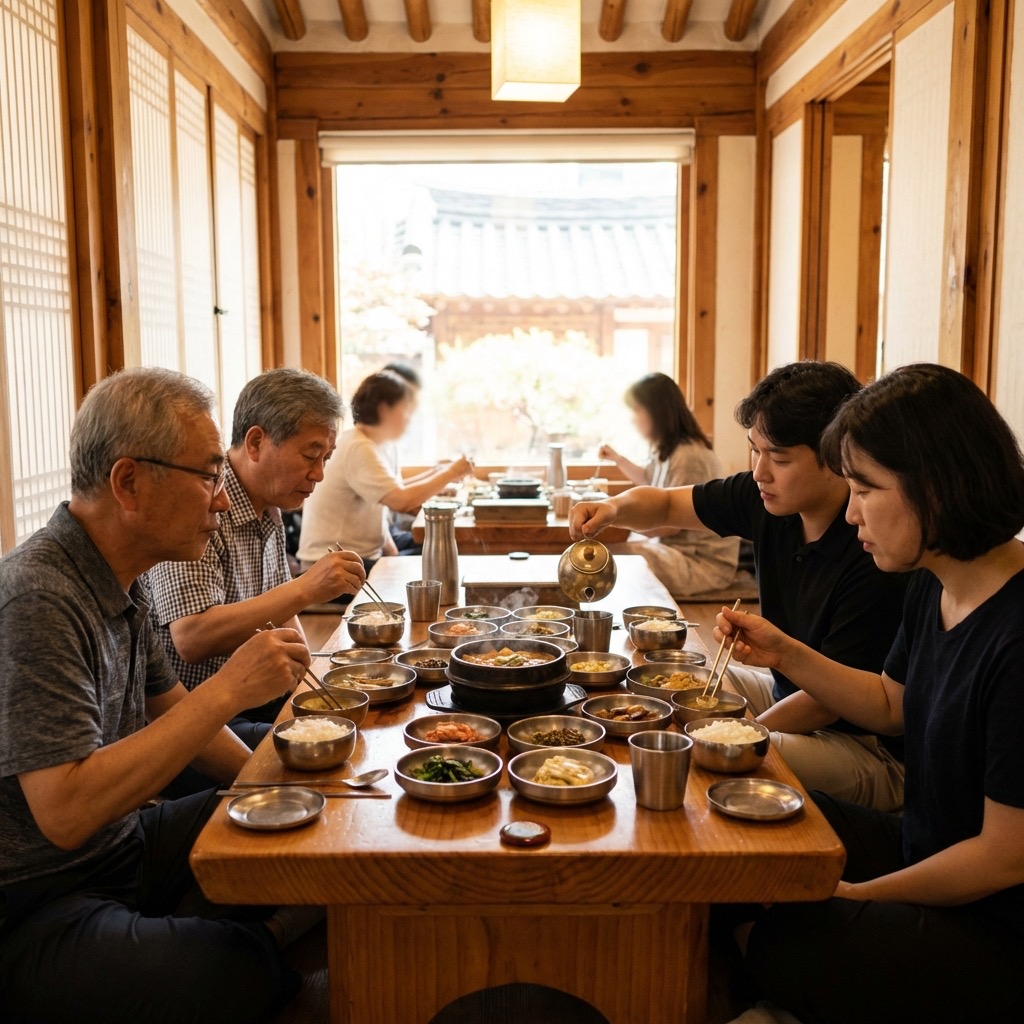
The moment you sit down at a Korean table, the meal has already begun — and so has the etiquette. Korean dining culture is governed by centuries of Confucian values that turn every shared meal into a ceremony of respect, hierarchy, and genuine human connection. Understanding these unwritten rules will not only save you from awkward glances but will earn you the warmest possible welcome from Korean hosts.
Why Korean Dining Etiquette Matters: The Philosophy Behind the Food
Korean dining culture taught me that food is never just about eating. Every element of a Korean meal — the order in which people lift their spoons, the way a bottle of soju is poured, the unspoken rhythm of banchan sharing — reflects a worldview built on jeong (정), the deep sense of affection and connection between people, and nunchi (눈치), the art of reading a room without being told what to do.
Jeong is the invisible thread that ties Koreans to each other. When an elder serves you food before serving themselves, that is jeong. When someone constantly tops up your glass before it empties, that is jeong. The dining table is where jeong is practiced, tested, and expressed most vividly. Nunchi, meanwhile, means watching what everyone else does and calibrating your behavior accordingly — at a Korean dinner table, it means noticing that the eldest guest has not yet picked up their chopsticks and quietly keeping your hands in your lap.
The philosophical backbone of all this is Confucianism, which shaped Korean society for centuries. The core principle is straightforward: age and social status determine how you give and receive. The eldest person at the table is served first, poured first, and always treated with visible deference. Understanding this single principle will unlock the logic behind almost every other rule on this list.
That said, Koreans are extraordinarily patient with foreigners. No one expects perfection on your first visit. What matters is the effort — the genuine attempt to honor the culture that has welcomed you to its table. Think of these rules not as a test to pass, but as a language to learn.
For a broader view of Confucian-influenced social customs beyond the dining table, see our guide to Korean social customs and respectful travel.
Rule 1: The Eldest Eats First — Always
This is the non-negotiable foundation of Korean dining etiquette. Do not pick up your spoon or chopsticks until the oldest person at the table has picked up theirs.
The Cultural Weight of This Moment
In practice, this rule is so deeply ingrained that Koreans do not even think about it consciously — they simply wait. When the eldest person lifts their spoon, it signals a kind of permission that releases everyone else from the suspension of waiting. If you reach for your rice the moment it arrives, eyes will flick toward you. It is not a catastrophe, but it is noticed.
The hierarchy extends further: ideally, the eldest is also seated in the most prominent position, usually facing the door or at the head of the table. If you are a guest, your host will guide you to the right seat. If they do not, simply wait and observe where others sit before choosing your own place.
Imagine you are at a Korean BBQ restaurant with three generations of a Korean family who have invited you to join them. The grandmother is at the table — talking, gesturing, making everyone laugh. Do not touch your chopsticks until she reaches for hers, even if the meat is sizzling right in front of you and smelling incredible. That self-restraint is the most eloquent compliment you can pay her.
What to Do If You Forget
You will be forgiven, always. A small bow and a soft "Joesonghamnida" (sorry) is more than enough. The effort counts.
Rule 2: Keep Your Bowl on the Table
In Japan and China, it is polite and common to lift your rice bowl to your mouth to scoop rice with chopsticks. In Korea, this practice looks out of place and slightly rude. The bowl stays on the table.
Spoon vs. Chopsticks: Knowing Which to Use
Korea is the only East Asian country where the spoon is genuinely equal in status to chopsticks. In fact, the spoon has a higher status role: it is used for rice and soup, while chopsticks handle the banchan side dishes. Using chopsticks to eat rice — instead of a spoon — is considered an awkward breach of form.
The logic is practical. Korean rice is typically short-grain and sticky enough to be scooped easily with a spoon. Korean soup, which always accompanies a full meal, requires a spoon. Chopsticks are for the array of side dishes — kimchi, spinach namul, braised potatoes, fish — that surround the main bowls.
A refined habit you will notice at formal Korean meals: Koreans alternate between putting down chopsticks while using the spoon, and putting down the spoon while using chopsticks. Holding both simultaneously is considered sloppy form.
Rule 3: The Chopstick Taboos You Must Know
Korean chopstick etiquette carries real cultural weight, and a few specific behaviors are genuinely offensive rather than simply impolite.
Never Stick Chopsticks Upright in Rice
This is the big one. If you drive your chopsticks vertically into a bowl of rice and leave them standing, you are mimicking the incense sticks placed upright in funeral offering bowls for the dead. At a casual dinner table, this evokes death in a way that is jarring and deeply unsettling to Korean diners. Always rest chopsticks horizontally on the chopstick rest beside your bowl, or lay them across the top of the bowl if no rest is provided.
Never Pass Food Chopstick to Chopstick
Passing food directly from your chopsticks to another person's chopsticks is another funeral ritual — specifically, the ceremonial passing of bones after cremation. If you want to offer someone a piece of food, place it on their plate or bowl first, then let them pick it up themselves.
No Hovering or Spearing
Hovering your chopsticks over multiple dishes while you decide what to eat next is called geomjip. It is considered greedy and indecisive. Make your decision, commit to it, and pick up the food cleanly. Similarly, stabbing food with a single chopstick as though it were a skewer is poor form — if the food is too difficult to pick up, use a spoon instead.
No Pointing
Waving chopsticks toward people while talking or pointing at a dish to draw attention to it is rude. Chopsticks are eating utensils, not conversation props.
Rule 4: The Two-Hand Pour — Pouring Drinks for Others
When pouring a drink for someone, especially an elder or a person of higher social standing, use both hands. The proper form: right hand holds the bottle, and the left hand supports the right wrist or elbow. When receiving a drink, hold your glass with both hands and give a slight bow of the head.
Why Two Hands?
This is an extension of the broader Korean two-hand rule that governs nearly all exchanges of respect — giving business cards, receiving gifts, handing over a credit card. One-handed giving signals indifference, as though you are tossing something away. Two hands signal that you are present, attentive, and that the person receiving your attention is worth the full effort of your body.
Never Pour Your Own Drink
In Korean dining culture, pouring your own drink — especially alcohol — when someone older is sitting at the table is considered bad luck and a social signal that you are not paying attention to others. The expectation is that you are watching your neighbor's glass and topping it up before it empties. In turn, someone should be watching yours. This mutual attentiveness is a physical expression of jeong.
If you find your glass empty and no one is filling it, the social move is to quietly offer to fill someone else's glass — which will prompt them to reciprocate.
For a deep dive into Korean drinking culture, including the full rules around soju, somaek, and anju food pairings, read our complete guide to Korean drinking culture and etiquette.
Rule 5: The Head Turn — Drinking in Front of Elders
When drinking alcohol in the presence of someone significantly older or of higher status, turn your head and upper body slightly away from them before taking your sip. Some people also cover their mouth and glass lightly with their free hand.
The Rationale Behind This Rule
Direct eye contact while drinking in front of a senior is read as casual disregard — as if to say, "I am comfortable enough to drink freely in your presence." The head turn acknowledges the hierarchy. It is a physical act of deference, similar to why you might not laugh loudly or sprawl in your chair at a formal dinner.
This rule surprises most first-time visitors more than any other. You will be sitting at a Korean BBQ table, everyone is relaxed, the soju is flowing, and then you take a sip and realize the Korean person next to you turned their head away. Now you know why.
The rule relaxes somewhat among close friends of similar age. Among university students sharing soju in Hongdae, you will see very little head-turning. But in a professional dinner or a family gathering across generations, it remains a meaningful gesture of respect.
Rule 6: Banchan Is Shared — But There Are Rules
The banchan are the small side dishes — kimchi, namul vegetables, braised fish, pickled radishes — arranged around the center of a Korean table. They belong to the group, not to individuals. Eating directly from a shared banchan plate is generally fine. But there are a few norms worth knowing.
The Art of Banchan Etiquette
Take reasonable portions. Do not scoop all the kimchi onto your bowl at once. Eat a little, pause, come back for more. This applies even when you genuinely love a particular banchan — restraint is part of the social grammar of sharing.
In most restaurant settings, the same banchan dish is refilled free of charge. This is one of the great joys of Korean dining: you can ask for more kimchi, more spinach namul, more fishcake, and it will be brought to you. The Korean phrase to ask for a refill is "Ri-pil haejuseyo" (리필 해주세요) — a word borrowed from "refill" that every diner should know.
At traditional or formal meals, you may see someone serve food from the communal banchan dishes onto your plate without asking. This is an act of care, not presumptuousness. Accept it graciously, and if you want to reciprocate, offer the same to someone else at the table.
One hygiene note: if a stew or soup is being shared from a communal pot — which is common with dishes like kimchi jjigae — some Koreans, particularly in formal settings, will use a separate serving spoon rather than eating directly from the pot with the spoon they use for their own bowl. In casual family meals, direct eating from the pot is perfectly normal. Follow the lead of your hosts.
Rule 7: Scissors Are Standard Cutlery
If a server materializes next to your table holding a pair of enormous metal kitchen scissors, do not be alarmed. This is standard Korean restaurant equipment.
What the Scissors Are For
Korean scissors are used at the table to cut grilled meat into bite-sized pieces at a Korean BBQ, to snip long sheets of kimchi, to cut cold noodles (naengmyeon) before eating, and to portion large vegetables. In many Korean BBQ restaurants, the server will do this cutting work for you as part of the service. At other restaurants, the scissors are left on the table for self-service.
The use of scissors at the table reflects the highly practical nature of Korean dining. Food is meant to be eaten communally and without fuss. The scissors ensure that even large, unwieldy pieces of food become easily shareable and manageable with chopsticks.
Rule 8: The Call Button and Yogi-Yo
Korean restaurant service operates on a call-when-needed model. Servers will not hover at your elbow and check in repeatedly. They will set the table, bring your order, and then stay out of your way until they are needed. This is not inattentiveness — it is the Korean preference for a meal undisturbed by constant interruptions.
How to Summon Your Server
Look for a small button mounted on the table or on a panel attached to the wall near the table. When pressed, it triggers a pleasant chime or a notification on the server's system. This is the polite and standard method of calling for service in most sit-down Korean restaurants.
If there is no button — common in market stalls, pojangmacha tents, and older neighborhood restaurants — raise your hand and say clearly: "Yogi-yo!" (여기요). It means "Over here!" and is universally understood. You will hear Koreans saying it without a second thought. Do not feel shy about it; a confident "Yogi-yo!" signals that you are a competent diner, not a demanding customer.
Rule 9: Water Is Self-Service (Mul-eun Self)
In the vast majority of Korean restaurants — from simple gimbap shops to medium-range sit-down restaurants — water is self-service. Look for a small sign near the water dispenser that reads "물은 셀프" (water is self). A pitcher of water or a dispenser will be accessible from your table or nearby.
What to Look For
Typically, you will find a refrigerator or dispenser with pre-chilled water, a pitcher on a side counter, or cups stacked next to a water machine. Help yourself and fill your glass as needed. If you are unsure where the water is, you can ask: "Mul eodie isseoyo?" (Water, where is it?).
Upscale or formal Korean restaurants are more likely to have servers who bring and refill water. But in the majority of everyday dining spots, waiting for someone to bring you water will leave you thirsty for a long time. Get up, find the dispenser, and fill your cup.
Rule 10: No Tipping — Seriously
Tipping is not part of Korean dining culture. Not at restaurants, not at cafes, not at traditional inns. Do not leave coins or bills on the table when you leave. Do not hand extra money to the server at the end. In many cases, the server will assume you forgot your change and will chase you out the door to return it.
Why Tipping Does Not Exist Here
Korean restaurant culture operates on the premise that good service is standard, not exceptional. Servers are typically paid a living wage that does not depend on tips. The tipping custom, common in the United States and some other countries, implies that service is variable in quality and that a customer's approval is expressed monetarily. This framing simply does not exist in Korea.
What this means for you as a traveler is wonderfully simple: the price on the menu is the price you pay. No mental arithmetic for the tip, no awkward moments calculating percentages. Just pay the bill at the register — in most Korean restaurants, you pay at the counter on your way out, not at the table — and go.
The Korean BBQ Experience: Putting It All Together
Korean BBQ is where most of the above rules converge in a single meal, which makes it the ideal context for practicing everything you have learned.
Imagine you are seated at a table with a built-in charcoal or gas grill. The server brings thick slices of samgyeopsal (pork belly) and galbi (marinated beef ribs), along with an array of banchan. A bottle of soju and glasses arrive. Here is how a well-calibrated evening unfolds:
The oldest person at the table lifts their glass. You pour for them with two hands. They pour for you. No one pours their own drink. Someone begins grilling the meat, often rotating the pieces with metal tongs. When the meat is ready, the server — or the person grilling — cuts it with scissors into small pieces.
Now comes the ssam — the wrapping technique. Take a piece of sesame or perilla leaf, place a piece of grilled meat on it, add a smear of ssamjang (the thick, garlicky dipping paste), a sliver of raw garlic, and perhaps a bite of kimchi. Fold the leaf around everything and eat it in one bite. This is the correct way to eat Korean BBQ. Eating ssam in multiple bites is messy and considered slightly inelegant.
When you drink your soju, turn your head slightly if there is an elder present. Refill glasses around you before your own. Let someone else refill yours. At some point, a round of somaek (soju mixed into beer) might be proposed, and the youngest person at the table will be given the honor of mixing it. The evening does not end at the table — in Korean dining culture, the meal is often just the first chapter of a night out, with noraebang (karaoke) following naturally as the next stop. Read our guide to experiencing noraebang and Korean karaoke culture if this is your first time.
Common Mistakes First-Time Visitors Make
Even with the best intentions, a few specific errors come up again and again among first-time visitors to Korea.
Reaching for food before the eldest. The most common mistake, and the most easily avoided. Simply keep your hands in your lap until the senior at the table begins.
Filling their own glass. Visitors used to Western dining often reach for the bottle and pour for themselves out of habit. In Korea, the correct move is to offer the bottle to someone else first.
Using chopsticks for rice. Scoop your rice with a spoon. This alone will make you look like someone who has been to Korea before.
Hovering chopsticks over the banchan. Decide quickly, take cleanly. Hovering is read as indecision and signals that you are treating the shared dishes as a personal buffet.
Sticking chopsticks upright in rice. Even briefly, even just to free up your hands — avoid it entirely. Rest them on the chopstick holder or across the edge of your bowl.
Tipping. It will confuse your server and may cause mild embarrassment. Pay at the counter and say "Jal meogeossseumnida" — it is the correct and warmly received way to close a meal.
Blowing your nose at the table. If you need to blow your nose, excuse yourself and do it in the restroom. Sniffling quietly is tolerated; audible nose-blowing at the table is genuinely off-putting in Korean dining culture.
Useful Korean Phrases for Dining
A small arsenal of Korean phrases at the dinner table will endear you to any host and smooth every interaction.
| Phrase | Korean | When to Use |
|---|---|---|
| I ate well / That was delicious | 잘 먹었습니다 (Jal meogeossseumnida) | After finishing a meal |
| Let us eat | 잘 먹겠습니다 (Jal meokgetseumnida) | Before starting a meal |
| Over here, please | 여기요 (Yogi-yo) | To call a server |
| Please give me a refill | 리필 해주세요 (Ripil haejuseyo) | For more banchan |
| Not spicy, please | 안 맵게 해주세요 (An maepge haejuseyo) | Ordering mild food |
| I cannot drink alcohol | 저는 술 못해요 (Jeo-neun sul mot-hae-yo) | Politely declining |
| Where is the water? | 물 어디에 있어요? (Mul eodie isseoyo?) | Finding the self-service water |
| Cheers! | 건배! (Geonbae!) | Toasting |
The phrase "Jal meogeossseumnida" deserves special mention. Saying this as you leave a restaurant or after someone has prepared food for you is one of the most warmly received gestures a foreigner can make. It is the equivalent of telling a chef or host that their meal was worth your full attention — and in Korean food culture, that is a meaningful compliment.
Regional Dining Differences Across Korea
Korean dining etiquette is fairly consistent across the country, but there are regional nuances worth knowing if you are traveling beyond Seoul.
Jeonju: The Formal Table
Jeonju, designated a UNESCO City of Gastronomy, takes its food traditions seriously. A full hanjeongsik meal in Jeonju — the traditional table d'hote of Korean cuisine — can involve 20 or more banchan dishes arranged with careful attention to color, nutrition, and harmony. In this context, the expectation of formal etiquette is higher. Pacing yourself through a hanjeongsik meal is an art: do not rush through the courses, do not pile banchan into your rice bowl all at once, and take time to taste each dish separately before combining flavors. For the full experience, see our guide to Jeonju Hanok Village and its food culture.
Busan: Relaxed and Direct
Busan has a reputation for being more direct and less formal than Seoul. The port city culture values warmth over ceremony. Dining etiquette still applies, but the atmosphere at a Busan gukbap (rice soup) restaurant — where you are expected to season your own bowl with fermented shrimp and garlic — is more relaxed and hands-on. Nobody will look twice if you lean across the table to grab the communal kimchi.
Traditional Restaurants with Floor Seating
Across Korea, particularly in older neighborhoods and traditional-style restaurants, you may be seated on the floor at a low table. This means removing your shoes at the entrance — look for the raised floor level and a shoe rack. The etiquette inside is the same, but the physical arrangement changes: do not stretch your legs out toward other diners, as this can be seen as disrespectful. Sit cross-legged or kneel. Women in traditional settings often sit with their legs tucked to one side.
Makgeolli Culture in the Provinces
In rural areas and traditional markets, makgeolli (rice wine, served in a large bowl or kettle) is the drink of choice, especially paired with savory pajeon (scallion pancakes). In Jeonju's famous Makgeolli Alley, the custom is to order a kettle of rice wine and receive a parade of free side dishes with each refill. This tradition of generous hospitality through food is a regional expression of jeong at its most tangible. Understanding Korean food culture through its regional lens is the subject of our culinary journey through Korea's regional specialties.
After Dinner: The Korean Dining Ritual Does Not End at the Table
One of the things that surprises visitors most about Korean social dining is that the restaurant is often just the first stop of the evening. Korean social culture follows a concept called cha (차) — literally "round" or "time." The first cha is dinner. The second cha might be a bar or a pojangmacha tent for more drinks. The third cha is almost inevitably noraebang.
Understanding this rhythm helps you be a better guest. If your Korean friends invite you to dinner and then suggest a second round, they are not asking whether you are still hungry. They are inviting you to continue the evening together. Accepting, at least for one more round, is a sign of genuine engagement with the culture.
The broader point is that Korean dining is not a transaction to be completed efficiently. It is a social experience measured in hours, shared plates, clinked glasses, and the gradual deepening of connection that happens when people eat together over time. That is jeong in action.
Final Thoughts: Confidence Over Perfection
Korean dining culture is rich, layered, and rooted in a genuine philosophy of care and respect. But no Korean host expects a first-time foreign visitor to arrive fully fluent in every nuance. What they appreciate — what will genuinely move them — is the visible effort to honor the culture they have invited you into.
Know the big rules: wait for the eldest, pour for others before yourself, keep the chopsticks off the rice bowl. Learn a phrase or two. Accept the banchan that someone puts on your plate. Turn your head when you take your soju shot. The rest will come naturally as you share more meals.
Korean food is extraordinary — spicy, fermented, communal, and deeply tied to the land and the seasons. If you want to understand it more deeply, start with the philosophy of how it is eaten, not just what is on the plate.
Hungry for more? Explore the full landscape of Korean food culture in our foodie's guide to South Korea's must-try dishes and markets, and learn how Korean cuisine has evolved from royal court to modern street food. Jal meogeossseumnida — eat well, travel well, and always fill your neighbor's glass before your own.